Author: Tej

  • CBSE to GCSE Conversion Explained: Grades, Differences & How to Help Your Teen Succeed

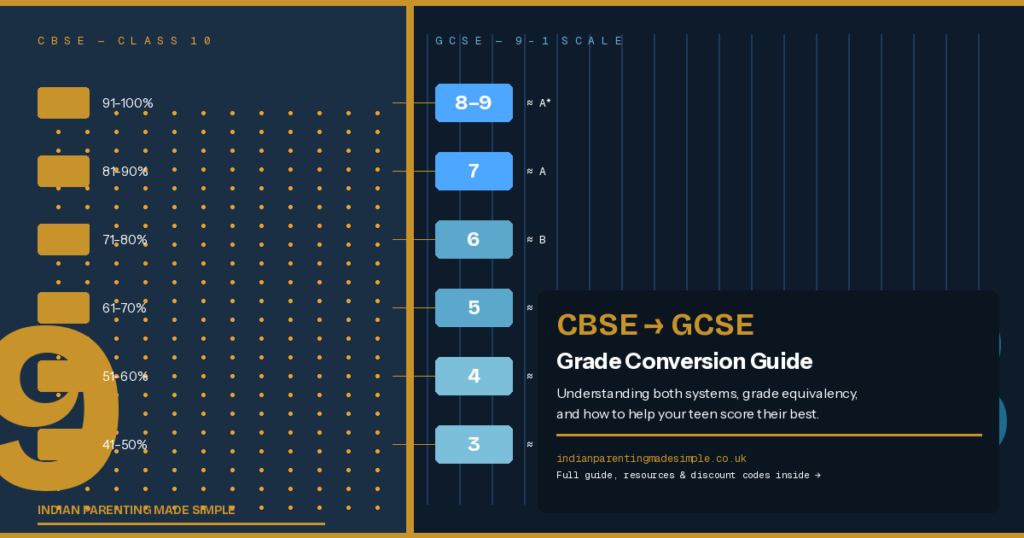
    Infographic showing CBSE to GCSE grade conversion — left panel shows CBSE Class 10 percentages (A1 at 91–100% through to C1 at 51–60%), connected by arrows to GCSE 9–1 grades (8–9 down to 4) on the right panel, with old A–G equivalents. Navy and gold colour scheme. Text reads: CBSE → GCSE Grade Conversion Guide.

    If your family has recently moved to the UK from India — or if you are researching your child’s academic pathway — one of the first questions you’ll face is: “How do my child’s CBSE grades translate to GCSE results?” It feels like comparing apples with mangoes. Both are real qualifications and rigorous. But they are scored, structured, and assessed in completely different ways.

    This guide cuts through the confusion. We will show you exactly how the two grading systems compare. In addition, we will walk you through the key differences in how students are taught and examined. And give you practical strategies — as a parent — to help your teenager thrive in the GCSE environment.

    Understanding the Two Grading Systems

    How CBSE Grades Students?

    The Central Board of Secondary Education (CBSE) operates a percentage-based system for Class 10 (the All India Secondary School Examination, AISSE). Students receive a raw percentage score in each subject, and some schools also report a Cumulative Grade Point Average (CGPA) on a scale of 0–10. The CBSE official formula for converting CGPA to percentage is straightforward:

    Percentage = CGPA × 9.5   |   Example: CGPA 9.0 → 85.5%

    Grade boundaries under CBSE follow an A1–E2 grading band, where A1 (91–100%) is the highest and, a student must score at least 33% in each subject to pass. Crucially, CBSE focuses heavily on content recall, particularly in Maths and Science, which is why Indian students typically perform very strongly in these subjects.

    How GCSE Grades Students?

    GCSEs (General Certificate of Secondary Education) are taken in England, Wales, and Northern Ireland, typically at the end of Year 11 (ages 15–16). Since 2017, they have used a numerical 9–1 grading scale rather than the old A*–G letters.

    Grade 9 is the top mark awarded to only the very highest performers nationally. Whereas, Grade 4 is considered a ‘standard pass’ and a minimum that most sixth forms and colleges require. The assessment is primarily through end-of-course written examinations. It has limited coursework in practical subjects like Art or Design & Technology.

    CBSE to GCSE Grade Conversion Table

    There is no official government-issued CBSE to GCSE conversion table, and grades cannot be converted on a one-to-one basis. However, the table below provides the widely-accepted equivalency used by sixth forms, universities, and credential evaluators (such as UK ENIC, formerly NARIC) when assessing international students:

    CBSE PercentageCBSE Grade (A1–E)GCSE Grade (9–1)Old GCSE Grade (A*–G)
    91% – 100%A18 – 9A*
    81% – 90%A27A
    71% – 80%B16B (high)
    61% – 70%B25B / C (high)
    51% – 60%C14C
    41% – 50%C23D
    33% – 40%D2E – F
    Below 33%E / Fail1 / UG / U
    Important: A student who scores 85% in CBSE Maths is broadly equivalent to a GCSE Grade 7. A student scoring 95%+ could be considered Grade 8–9 level. Always check with the specific institution, as grade boundaries differ by subject and exam board (AQA, Edexcel, OCR).

    5 Key Differences Between CBSE and GCSE You Need to Know

    1. Assessment Style: CBSE exams are largely knowledge-based and reward detailed recall. GCSE exams, by contrast, place a strong emphasis on analytical thinking, extended writing, and applying knowledge to new scenarios. Many students from CBSE backgrounds find this shift the hardest to adjust to.

    2. English Language Requirements:  UK ENIC and most universities recognise CBSE Class 10 as broadly equivalent to GCSEs — but not for English Language. If your child needs to demonstrate English proficiency, they will typically need to sit GCSE English Language, IGCSE English, or an alternative such as IELTS (minimum 6.0) or Pearson PTE Academic.

    3. Subject Choice:  CBSE students study a defined national curriculum. GCSE students choose 8–10 subjects, with only English, Maths, and Science being compulsory. This gives UK students more subject freedom but means your child may need to catch up on subjects they have not formally studied.

    4. Grading Distribution:  In GCSE, a Grade 9 is intentionally rare — only around 3–5% of all entries nationally receive it, depending on the subject. This is very different from CBSE, where scoring 90%+ is relatively more common. So a GCSE 7 (equivalent to an ‘A’) is genuinely excellent.

    5. Coursework vs. Exams:  Most GCSE subjects are now assessed almost entirely through final exams at the end of Year 11. There is very little ongoing coursework, unlike the CBSE Continuous and Comprehensive Evaluation (CCE) system which distributes assessment throughout the year.

    Is your child specifically making the jump in Year 9? Read our in-depth guide: Moving from CBSE to GCSE Year 9 — How is it Different from Indian 8th/9th Grade? for a detailed breakdown of subject-by-subject changes, exam boards, and which revision books to buy first.

    How Parents Can Help Their Teens Score Well in GCSEs

    Parental involvement is one of the strongest predictors of GCSE success. Here is a practical playbook, specifically tailored for families coming from a CBSE background.

    Start Revision Early — At Least 5 Months Before Exams

    GCSE exams run in May and June, so January — after the mock exam period — is the ideal time to begin structured revision. A useful calculation: for each GCSE subject, allow roughly 1 hour of revision per topic. If a subject has 50 topics, that is 50 hours. Multiply across 8 subjects and your child needs approximately 400 hours of revision. Starting early makes this manageable — cramming does not.

    Understand the Mark Scheme — It Is Different to CBSE

    This is the single most important shift for CBSE-background students. GCSE examiners award marks for structured answers — they use ‘point mark’ and ‘levels mark’ schemes. Download past papers and mark schemes from the relevant exam board website (AQA, Edexcel, or OCR) and practise answering questions the GCSE way: with evidence, reasoning, and clear structure.

    Build a Dedicated Revision Routine

    Help your teenager create a weekly timetable that covers all subjects equally. Research consistently shows that short, focused sessions of 25–45 minutes with regular breaks are more effective than marathon study sessions. Alternate subjects to avoid mental fatigue, and include at least one full day off per week.

    Looking for a fun, collaborative way to get your teen invested in their own goals? Our 2026 Vision Board Ideas for Teens & Desi Parents shows you how to use a fusion vision board to align your teen’s GCSE ambitions with their wider personal goals — a powerful way to build motivation from the inside out.

    Focus Especially on English Language

    This is the area where CBSE-background students most often need additional support. GCSE English Language requires students to read unseen texts, identify language techniques, and write extended responses. These skills are rarely practised in CBSE preparation. Consider a tutor, past paper practice, or a structured revision guide specifically for GCSE English.

    Use Active Revision Techniques

    Passive reading is the least effective revision method. Encourage your child to:

    • Use flashcards (physical or apps like Anki or Quizlet) for facts and vocabulary
    • Practise timed past papers under exam conditions
    • Explain topics out loud or ‘teach’ them to you — a technique proven to deepen understanding
    • Use mind maps for subjects like History, Geography, and Biology
    • Watch subject-specific YouTube channels such as The GCSE Maths Tutor

    Manage Stress and Wellbeing

    GCSEs are a high-pressure period. Ensure your teenager gets adequate sleep (8–9 hours), eats well, and has time for activities they enjoy. Keep conversations about exams positive and focused on effort rather than outcomes. If stress becomes severe, speak to your child’s school pastoral team early.

    The way you communicate with your teen during exam season matters enormously. If you feel the pressure is creating distance between you, our guide on How to Build and Improve Your Relationship with Your Teenager offers practical, culturally relevant advice for Indian parents on keeping communication open — especially when GCSEs are on the line.

    What GCSE Grades Does Your Child Need?

    Understanding the minimum grade requirements helps your child set meaningful targets:

    • Grade 4 (‘Standard Pass’) — minimum for most sixth forms and colleges to continue studying any subject
    • Grade 5 (‘Strong Pass’) — required for more competitive sixth form courses and preferred by many universities as evidence of secondary school attainment
    • Grade 7+ — required for the most competitive A-Level subjects (e.g., Further Maths, Sciences at selective schools)
    • Grades 8 or 9 — place a student in the top 3–10% nationally; excellent for Oxbridge aspirations
    For students transitioning from CBSE: if your child scored 80%+ consistently across CBSE subjects, they have a solid academic foundation to aim for Grade 6–7 in GCSEs, provided they adapt to the different assessment style.

    Recommended Books & Resources (Amazon UK)

    Below you will find tried-and-tested resources that are widely used by GCSE students across the UK. They are a worthwhile investment for any family supporting their teenager through this critical period:

    Revision Guides (Available on Amazon UK)

    Exam Technique & Practice Papers

    Always check which exam board your child’s school uses (AQA, Edexcel, or OCR) before buying revision guides — the content and question style differs between boards. Your child’s teacher or school website will confirm this.

    Free Online Resources

    Below are free online tools used by millions of UK students every year. They are particularly helpful for getting familiar with the GCSE exam style that CBSE students often find most challenging.

    BBC Bitesize (Free)

    • GCSE Revision Tips & Study Techniques — BBC Bitesize’s core guide to effective GCSE revision, covering how to plan your study time and get the most from revision sessions.
    • GCSE Exam Revision Resources Hub — The central BBC Bitesize GCSE hub, with free subject-by-subject revision content, quizzes, and videos across Maths, Sciences, English, and more.
    • How to Revise Effectively for GCSEs — A practical BBC Bitesize article on evidence-based revision methods including active recall, spaced repetition, and exam technique — the exact skills CBSE students need to build for GCSE success.

    Exam Board Websites (Free Past Papers & Mark Schemes)

    • AQA (aqa.org.uk) — The most widely used exam board in England. Download past papers and mark schemes for every subject directly from their website — free of charge.
    • Edexcel / Pearson (qualifications.pearson.com) — Very common for GCSE Maths and Business Studies. Past papers and specification documents are available under each subject page.
    • OCR (ocr.org.uk) — Popular for Computer Science and many Humanities subjects. Check which board your child’s school uses — it differs by subject and school.

    YouTube

    • The GCSE Maths Tutor (YouTube) — One of the UK’s most highly rated free GCSE Maths channels. Covers every topic clearly with worked examples — especially useful for students who are strong at Maths from CBSE but need to learn the GCSE mark-scheme approach.

    Save My Exams: Track Progress & Practice Past Papers

    One platform that stands out above almost everything else for GCSE revision is Save My Exams. It specifically supports students transitioning from a CBSE background. Over 2.5 million students use it every month. The system follows the exact marking criteria used by GCSE examiners. Hence, understanding the marks scheme is the single biggest adjustment CBSE-background students need to make.

    How is it useful for CBSE-to-GCSE Students?

    Unlike revision guides that simply summarise content, Save My Exams prioritises active practice and real exam feedback. The two things most CBSE students lack when they first start GCSEs. Here is what the platform offers:

    Past exam questions by topic

    The platform categorises past exam questions by subject, topic, and difficulty level, preventing your child from feeling overwhelmed. Therefore, they can start with easier questions in a new topic and build up — exactly the right approach when adapting from CBSE’s style to GCSE’s mark-scheme logic.

    Smart Mark (AI-powered feedback)

    This feature is a game-changer for CBSE students. After answering a question, Smart Mark compares the response to the official mark scheme. In addition, it provides instant, specific feedback on exactly where marks were gained or lost. Therefore, no waiting for a teacher, and no guessing. Your child learns the examiner’s logic in real time.

    Strengths & Weaknesses tracker

    As a parent, this is the feature you will value most. Save My Exams tracks your child’s performance across every topic and shows you clearly which areas are strong and which need more work. You do not need to wait for a school report to know where to focus revision time.

    Exam-board aligned revision notes

    The content matches AQA, Edexcel, OCR, and WJEC specifications, since it is written by experienced teachers and examiners. Nothing extra, nothing missing — just precisely what your child’s examiners expect.

    Mock exams with instant scoring

    Full-length practice papers that mimic real GCSE exam conditions. Students receive a score and detailed solutions immediately, helping them build both technique and confidence well before exam day.

    Flashcards

    Expert-written flashcards for active recall revision, covering key terms, definitions, and concepts across all major GCSE subjects.

    Exclusive Discount — 10% Off Save My Exams Indian Parenting Made Simple readers can get 10% off a Save My Exams subscription by using the discount code at checkout: NRX998 Visit savemyexams.com and enter code NRX998 at checkout. Premium plans start from £4/month — less than the cost of a single revision guide, with access to all subjects and all exam boards.

    The results speak for themselves: 97% of Save My Exams members report getting better grades, with students improving by an average of 2.6 grades. Hence, for a student transitioning from CBSE who needs to quickly master GCSE exam technique, this platform shortens that learning curve significantly.

    Summary: What CBSE to GCSE Conversion Really Means

    The CBSE to GCSE conversion is not a simple number swap — it is a transition between two different educational philosophies. CBSE rewards depth of knowledge and recall; GCSEs reward application, analysis, and exam technique. Understanding this distinction is the first step to helping your teenager succeed.

    Students who scored 80–90% in CBSE are broadly equivalent to GCSE Grade 6–7, and those scoring 90%+ could achieve Grade 8–9 with the right preparation. The key differences to address are: GCSE-style answer technique, English Language proficiency, and consistent exam practice from early in Year 11.

    Hence, a student coming from CBSE is absolutely well-equipped to achieve outstanding GCSE results. As long as they have the right resources, a structured revision plan, and strong parental support,

    Always verify grade equivalency requirements with the specific UK institution your child is applying to. For official credential recognition, contact UK ENIC (enic.org.uk).fficial credential recognition, contact UK ENIC (enic.org.uk

    If you are looking for GCSE Revision course for Easter or other holidays, MyEdSpace has some really good course.
  • Moving from CBSE to GCSE Year 9. How is it different from Indian 8th/9th grade?

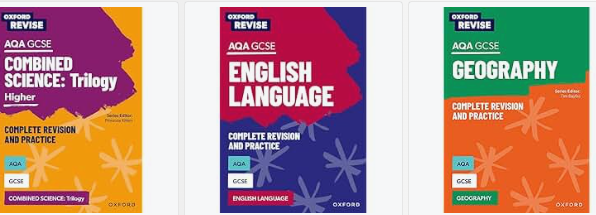
    Three Oxford Revise AQA GCSE revision guides for Combined Science Trilogy, English Language, and Geography, shown side-by-side is a good resource to have when moving from CBSE to GCSE Year 9 UK.

    Is your child moving from CBSE to GCSE Year 9? For many Indian teens and parents, the transition feels like a world of difference. Back home, 8th and 9th grades are defined by heavy memorization and rigorous coaching, but the UK system focuses on a different set of skills: critical thinking and real-world application.

    Before diving into the academic shifts, make sure you have the basics of your relocation covered by checking out Your Guide to Moving to the UK from India with Teens.

    Once you’ve settled in, understanding the jump from the Indian board system to the British curriculum is the next step. Here is everything you need to know about how Year 9 works and how to help your child succeed.

    Key Differences between GCSE and CBSE:

    Less Homework, More Independent Learning

    Your teen will get less daily homework than in India. UK schools focus more on project-based work and expect students to research and think critically rather than memorize.

    Different Teaching Style

    Teachers encourage questioning and debate in class. Your child asking “why?” is seen as engagement, not disrespect! This can feel strange at first.

    Subject Choices Coming Soon

    In Year 9, your teen will start choosing their GCSE subjects (exams taken in Year 11). This is earlier than India where the “stream” choice comes later. Start discussing their interests now.

    Assessment Methods

    Less emphasis on one big exam. More weight on coursework, presentations, and ongoing assessments throughout the year.

    Pastoral Care

    UK schools have strong “safeguarding” – form tutors, head of year, and counselors actively monitor your child’s wellbeing, not just academics.

    My Advice: Give your teen a term to adjust. The “easier” feeling is temporary – GCSEs will be rigorous! Encourage them to join clubs to settle in and make friends.

    How are subjects taught in GCSE?

    The “Calculated” Difference (Maths & Science)

    In India, 9th grade often involves heavy mental math and complex derivations. In Year 9, students begin using scientific calculators regularly. However, the UK focus is on interpreting data and explaining the “how” in long-form science answers, rather than just solving the equation.

    English: From Grammar to Analysis

    In the Indian system, English is often about comprehension and grammar. In Year 9, it shifts to English Literature—analyzing themes, metaphors, and the “writer’s intent” in Shakespeare or modern poetry. This is often the hardest adjustment for students moving from CBSE/ICSE.

    The Grading Language

    Instead of percentages (e.g., “I got 90%”), your child will likely hear about target grades (1–9). A ‘4’ is a pass, while an ‘8’ or ‘9’ is equivalent to an A*. Understanding this early prevents “grade panic” when the numbers look low compared to Indian marks.

    The Importance of “Extracurriculars”

    In the UK, these aren’t just hobbies; they are part of a student’s profile. Year 9 is the perfect time to start the Duke of Edinburgh (DofE) Award, which is highly valued for future university applications—something that doesn’t really have a direct CBSE equivalent.

    Pro-Tip: Check the school’s “VLE” (Virtual Learning Environment) like Google Classroom or Satchel One. Unlike the “diary” system in India, almost all UK homework and resources are managed digitally. If you don’t check the app, you might think they have no homework!

    The Different Exam Boards

    While all boards follow the UK National Curriculum, they “package” the information and exams differently. Your child might study AQA for Science but Edexcel for Maths.

    Exam BoardKnown For…
    AQAThe most popular board in the UK, especially for Sciences and English. Their questions often use real-world contexts.
    Edexcel (Pearson)Very common for Mathematics and Business Studies. They are known for logically structured papers.
    OCRAffiliated with Cambridge University. They often focus on critical thinking and are popular for Computer Science.
    WJEC / EduqasThe Welsh board, but its “Eduqas” brand is used frequently in England for English, Drama, and Media Studies.

    Action Step: Ask your child to check their subject list (or school portal) to see which board they are using for each subject. You need this info before buying any books!

    How Revision Workbooks Help

    In India, students often rely on one thick textbook (like NCERT). In the UK, the focus is on active recall. Revision workbooks are designed to be “written in” rather than just read.

    • Breaking Down the “Blob”: GCSE specifications are huge. Workbooks like CGP or Pearson Revise break topics into “one-page summaries” that are much less intimidating than a 300-page textbook.
    • Matching the Exam Style: A workbook for “AQA Biology” will use the exact type of phrasing the AQA examiners use. This helps your child learn how to “decode” the questions.
    • Bridging the Gap: For a student coming from a CBSE background, these books help transition from “writing everything I know” to “writing exactly what the mark scheme requires.”

    Which GCSE Books Should You Buy?

    You will see three main types of books in UK shops (like WHSmith or Amazon):

    1. Revision Guides: These contain the “notes” and explanations.
    2. Workbooks: These are full of practice questions (no notes).
    3. The “All-in-One”: These combine the notes and the questions in one book. (Highly recommended for Year 9).

    Popular Brands: > * CGP: Famous for their silly jokes and clear diagrams—most UK students swear by them.

    • Pearson/Oxford: More “academic” and formal, often used for higher-tier Maths and Sciences.
    SubjectRecommended Resource TypeWhy?
    MathsWorkbook with Worked ExamplesTo practice the specific steps required for UK marks.
    English Literature“York Notes” or CGP Text GuidesTo understand the specific poems or plays (e.g., Macbeth).
    ScienceKnowledge OrganisersTo memorise the specific “required practicals” for the UK syllabus.

    The “Open Formula” Shift: Application vs. Memorization

    One of the biggest surprises for students moving from India is the Formula Sheet.

    For exams in 2025, 2026, and 2027, the UK government (Ofqual) has confirmed that students will be provided with formula sheets for GCSE Maths, Physics, and Combined Science.

    What this means for your child:

    • Less Rote Learning: They won’t spend hours memorizing complex equations like the Quadratic Formula or Kinetic equations. They will have them right there on a sheet during the exam.
    • It’s Not “Easy”: Don’t let the formula sheet fool you! While the formula is provided, the question won’t tell them which one to use.
    • Context is King: UK exam questions are often “wordy” and based on real-life scenarios (e.g., calculating the pressure of a diver at a certain depth). Your child must be able to read a paragraph, extract the data, and select the correct formula from the sheet to solve it.
    • Practice with the “Insert”: Good revision workbooks (like CGP or Collins) now include a replica of the actual 2026 formula sheet. This helps students get used to looking up the info quickly rather than panicking during the real exam.
    • Step-by-Step “Decoding”: Many UK workbooks have “Worked Examples” that show how to pick a formula apart. This is the best way to train for the shift away from the CBSE style.

    Parent Tip: In India, if you know the formula, you usually get the marks. In the UK, the marks are in the application. Encourage your child to practice “decoding” questions rather than just reciting equations.


      The Rise of Revision Flash Cards: Quality Over Quantity

      In India, “studying” often means reading a chapter over and over. In the UK, students are taught that testing yourself is better than reading. Revision Flash cards are the most popular way to do this.

      • What are they? They are small, sturdy cards with a question or keyword on one side and a concise answer, diagram, or formula on the other.
      • Why they work: They force the brain to “fetch” the information. This “memory workout” makes the knowledge stick much longer than just passive reading.
      • Spaced Repetition: Many parents use the Leitner System with these cards—sorting them into piles based on how well the child knows them. The “hard” cards get reviewed every day, while the “easy” ones are reviewed once a week.

      Premade vs. DIY Flash Cards

      You’ll see two main types of cards in the UK, and both have their fans:

      1. Premade Revision Flash Cards (CGP, Collins, Oxford): You can buy sets specifically for your child’s exam board (e.g., AQA Biology). These are great because they cover every single point in the official syllabus, so you know nothing is missed.
      2. Hand-made Flash Cards: Many teachers encourage students to make their own using blank “index cards” from shops like Ryman or Tesco. The act of writing the card itself is actually the first step of learning!

      Digital Flashcards (The Modern Way)

      If your teen is tech-savvy, they might not even use physical cards. Many UK students use apps like Quizlet or Anki. These apps use algorithms to show the child the topics they struggle with more often, making revision very efficient.

      Conclusion: Embrace moving from CBSE to GCSE

      Transitioning from the Indian school system to the UK’s Year 9 is about moving from a “learning to know” mindset to a “learning to apply” approach. While the initial lack of heavy daily homework might feel like a drop in rigor, it is actually a shift toward independent research and critical thinking—skills that are vital for success in GCSEs and beyond.

      The key to a smooth transition is stay involved without over-pressuring. By understanding the exam boards, utilizing active recall tools like revision cards, and focusing on pastoral well-being, you can help your teen navigate this change with confidence.

      My Final Advice: Don’t worry if the first term feels like a “settling-in” period. Give your child the space to explore their new environment, join clubs, and get used to the UK teaching style. The foundation they build in Year 9 will be the springboard for their future academic success!

    • 2026 Vision Board Ideas for teens & parents: Bridge the Gap


      A 2026 Fusion Vision Board digital collage featuring polaroid-style photos of a person writing in a notebook, friends laughing outdoors, a close-up of henna art, and a family cooking together. Text sections highlight "Heritage Goals" like connecting with family and "UK Life Goals" focused on school and friendships.

      “Mum, where do I actually belong to?” If you’ve heard this question from your teen, you’re not alone. According to recent research on Third Culture Kids (TCKs), older adolescents are significantly more likely to struggle with identity adjustment, with studies showing that teens experience what researchers call “belonging everywhere and nowhere” – a profound sense of cultural displacement that affects their identity development and sense of belonging. I have found a way to mix both worlds in this blog. You will find my 2026 vision board ideas for teens helpful and actionable.

      For Indian parents raising teens in the UK, this identity struggle isn’t abstract – it’s the daily reality of watching your child navigate British school life while trying to maintain connections to Indian heritage. Research reveals that what takes teens through these “flips” between two different worlds requires tremendous emotional adjustments, mental resiliency, and constant retuning of who they are.

      But what if, instead of forcing your teen to choose between being Indian or British, you could help them create a vision that celebrates both?

      Enter the 2026 Vision Board for teens – a practical, research-backed family activity that transforms the tension between two cultures into a bridge of possibilities.


      Understanding the Real Struggles: What Reddit and Parents Are Actually Saying

      The Pain Points Desi Parents Face

      When you search parenting forums and Reddit threads, the same concerns appear repeatedly from Indian parents in the UK:

      “My teen doesn’t want Indian friends” – Parents worry their children are rejecting their heritage by avoiding other South Asian peers, not realizing that teens are trying to avoid being typecast into the “Asian group” while they’re still figuring out their own identity.

      “They’re embarrassed of our culture” – From hiding when parents wear traditional clothes to school events, to cringing when Hindi is spoken in public, parents feel hurt by what seems like rejection.

      “We can’t communicate anymore” – The language barrier isn’t just linguistic. Research shows that bicultural teens face challenges regarding their cultural background and need spaces where they can freely explore and embrace their dual identities without judgment.

      “How do I balance freedom with values?” – UK parenting norms differ dramatically from traditional Indian approaches, leaving parents uncertain about boundaries, curfews, and independence.

      What Teens Are Actually Struggling With

      Meanwhile, teens are posting their own struggles:

      • Identity confusion: Research confirms that TCKs do not experience confusion from the multiplicity of their identity itself, but rather struggle because it doesn’t fit the current social construction of identity.
      • Peer pressure vs. family expectations: Having to explain why they can’t do what “everyone else” is allowed to do.
      • Loneliness: Studies indicate that nearly 40% of Third Culture Students drop out of their first university institution, partly due to difficulty forming and committing to friendships as a direct result of multiple relational losses during childhood.
      • Performance pressure: Balancing academic expectations with the reality that British teens face different pressures than parents experienced in India

      The Research: Why Third Culture Kids Need a Different Approach

      The Statistics You Need to Know

      Recent systematic reviews of Third Culture Kids (TCK) reveal crucial insights:

      1. Older adolescents struggle more: Research across 10 studies with sample sizes ranging from 39 to 272 TCK participants found that older adolescents were more likely to struggle with adjustment.
      2. Peer relationships are critical: Studies consistently show that peer relationships significantly influence socio-cultural adjustment outcomes for TCKs.
      3. Family support matters immensely: Family functioning, support, and cohesion are among the key factors that influence TCK adjustment.
      4. Identity isn’t the problem – the framework is: Contrary to popular belief, TCKs aren’t confused by their multiple identities; rather, their identity doesn’t fit the current social construction that expects singular cultural allegiance.

      What This Means for Parents

      The research is clear: you cannot force your teen to choose between cultures. Attempts to do so increase anxiety, reduce trust, and damage the parent-child relationship. Instead, parents need to create secure and inclusive environments where teens can freely explore and embrace their bicultural identity.

      This is where the Fusion Vision Board becomes transformative.


      The 2026 Fusion Vision Board for teens: A Practical Framework

      What Is a Fusion Vision Board?

      Unlike traditional vision boards that focus solely on individual goals, a Fusion Vision Board acknowledges that bicultural teens are navigating multiple worlds simultaneously. It creates intentional space for:

      • Heritage goals (connecting with Indian culture)
      • UK life goals (thriving in British society)
      • Fusion goals (creating their own unique blend)

      Why the 2026 Vision Board ideas for Teens Works

      According to therapist recommendations for desi families, the key is to “separate the problem from your teenager” and “find the middle ground” together rather than imposing solutions. The vision board facilitates exactly this collaborative approach.


      Step-by-Step Guide: Creating Your 2026 Fusion Vision Board ideas for teens

      Materials Needed

      • Large poster board or digital design tool (Canva for tech-savvy teens)
      • Magazines (both Bollywood and British publications)
      • Printed images from Pinterest/Instagram
      • Markers, stickers, decorative supplies
      • Photos from family trips and cultural events
      • Snacks (make it enjoyable!)
      • 2-3 uninterrupted hours

      The Three-Column Framework

      Column 1: Heritage Goals

      This section celebrates Indian culture on their terms. Examples:

      Cultural Skills:

      • “Master 3 new henna designs” (hands-on, shareable skill)
      • “Learn to make Dadi’s dal recipe” (connection through cooking)
      • “Improve conversational Hindi” (practical, not pressure-based)

      Family Connection:

      • “Video call with cousins in India monthly”
      • “Attend one cultural festival this year”
      • “Visit India in summer 2026”

      Critical Rule: Let them define HOW they engage with heritage. If they want to learn Bollywood dance through YouTube rather than formal classes, that’s valid.

      Column 2: UK Life Goals

      This honors their British identity and social world:

      Academic/Career:

      • “Complete A-levels successfully”
      • “Research university options” or “Degree Apprenticeships”
      • “Learn to drive”

      Social/Personal:

      • “Try rock climbing”
      • “Attend 3 concerts this year”
      • “Join a school club”

      Local Experiences:

      • “Explore 5 new places in London”
      • “Weekend day trips with friends”

      Column 3: Fusion Zone (The Magic Middle)

      This is where bicultural identity becomes a superpower:

      Sharing Culture:

      • “Host henna party for friends” (making culture cool, not forced)
      • “Teach friends to make samosas”
      • “Create fusion playlist (Bollywood + UK artists)”

      Personal Expression:

      • “Style Indian outfits with Western pieces”
      • “Start Instagram account showcasing both cultures”
      • “Write about bicultural experience”

      The Parent’s Vision Board (Essential!)

      Here’s the game-changer: you make one too. This shows:

      1. You’re also growing and learning
      2. Adults don’t have all the answers
      3. You’re in this journey together

      Your goals might include:

      • “Understand UK teenage culture better”
      • “Let go of comparisons with relatives’ children”
      • “Learn one British cultural tradition”
      • “Balance both cultures in my own identity”

      Making It Happen: Practical Implementation

      The 2026 Vision Board Setup

      Time: Choose a relaxed weekend afternoon

      Space: Kitchen table or living room – somewhere comfortable

      Atmosphere: Put on music they like (even if it’s not your preference)

      Snacks: Have both Indian and British treats available

      The Conversation Framework

      Instead of dictating, use these conversation starters:

      1. “What from our culture actually interests you?” (Not what you think they should like)
      2. “What do you wish I understood about your life here?” (Listen without defensiveness)
      3. “How can we make both worlds feel like home?” (Collaborative problem-solving)
      4. “What am I doing that helps? What isn’t helpful?” (Genuine curiosity)

      Setting Ground Rules Together

      According to licensed family therapists working with desi families, it’s crucial to “identify and respect differences of opinion” and “ask for middle ground rather than imposing it”.

      Have them help establish:

      • Non-negotiable family values (respect, education, safety)
      • Flexible areas (clothing, music, friend choices)
      • How you’ll handle disagreements (pause, listen, compromise)

      Beyond the Vision Board: Family Activities

      Local Orpington Bonding Activities

      Creating the vision board is just the start. Here are activities that naturally blend both worlds for me. Below are places near Orpington. Feel free to look for similar activities near you:

      1. Cultural + Adventure: Priory Gardens Picnic Pack samosas and sandwiches, hang out at Priory Gardens. Let them bring friends. Make Indian food the “cool” option.

      2. Tech + Tradition: VR N3XT Bromley Located in the heart of Bromley, this VR arcade welcomes families and teens. Go together, then grab chai or coffee at a local café to discuss the experience.

      3. Creative Expression: The Walnuts Shopping Centre Shop together, but with a twist: help them find pieces to fusion-style Indian outfits with British fashion. Make it a collaborative style project.

      4. Active Bonding: Rhino Boulders Bromley Rock climbing requires trust and teamwork – perfect for rebuilding connection. The café has options for everyone.

      5. Friend Integration: Host at Home Use your vision board goals as a guide: if they wanted to “share culture with friends,” organize a movie night with Bollywood films and British snacks, or a cooking session making fusion food.

      London Day Trips That Honor Both Worlds

      Cultural Immersion:

      • Horniman Museum: Global perspectives that validate multicultural identity
      • Southbank Centre: Often hosts South Asian cultural events alongside British programming
      • Broadway Market or Camden: Diverse, multicultural spaces where “different” is celebrated

      Adventure Experiences:

      • Up at The O2: Scale the roof together – metaphor for navigating heights of two cultures
      • Thames River experiences: Literally navigating between different parts of London
      • Street food markets (Seven Dials, Mercato Metropolitano): Where fusion cuisine is celebrated

      Friend-Focused Activities:

      • Go-karting at Team Sport locations: Teens can bring friends; you can observe their social world
      • Escape rooms across London: Problem-solving together builds connection
      • Warner Bros Studio Tour: Shared cultural touchstone (Harry Potter transcends cultures)

      Addressing Common Challenges

      Challenge 1: “My teen won’t participate”

      Solution: Start smaller. Instead of a full board, ask them to choose just 3 goals total. Make it optional to share with you. Sometimes teens need autonomy before collaboration.

      Challenge 2: “They only choose UK goals, nothing Indian”

      Research insight: Development experts emphasize that forcing cultural engagement creates resentment, while providing opportunities to immerse themselves in both cultures allows them to “appreciate and connect with their roots” organically.

      Solution: Don’t force it. Plant seeds: “I’m learning to make better paneer. Want to try?” is better than “You must learn Indian cooking.”

      Challenge 3: “We can’t agree on anything”

      Solution: Use de-escalation techniques: avoid the word ‘but,’ replace with ‘and.’ Example: “I appreciate your choices, and I also have concerns I’d like to share. Let’s talk about your opinions first”.

      Challenge 4: “Language barrier is too strong”

      Research shows: Code-switching (mixing languages) is actually a cognitive superpower, not a deficiency.

      Solution: Embrace Hinglish. Use Hindi for emotional conversations, English for practical ones. Let them mix both naturally.


      Monthly Check-Ins: Keeping the 2026 Vision Alive

      The First Sunday Framework

      What to review:

      • Progress on goals (celebrate small wins)
      • What’s working/not working
      • Adjustments needed
      • New goals to add

      How to structure it:

      • 20 minutes maximum
      • No lectures, just curiosity
      • Equal speaking time
      • End on a positive note

      Signs It’s Working

      You’ll know the vision board is making an impact when:

      1. They initiate cultural activities (even small ones)
      2. They bring friends into your cultural world
      3. Communication increases (they share more freely)
      4. They show pride in both identities
      5. Conflicts decrease (shared framework reduces misunderstandings)

      Real Talk: What Success Actually Looks Like

      Success ISN’T:

      • ❌ Your teen is becoming “fully Indian” again
      • ❌ Perfect fluency in Hindi
      • ❌ Choosing only traditional career paths
      • ❌ Eliminating all British influence

      Success IS:

      • ✅ Your teen is comfortable with both identities
      • ✅ Open communication between you
      • ✅ They share your culture with friends proudly
      • ✅ You understand their world better
      • ✅ Both of you are growing

      Remember: Research indicates TCKs tend to be “experienced, open-minded, and flexible” – these are strengths, not weaknesses to be corrected.


      FAQs: Common Questions from Desi Parents UK

      Q: How do I handle relatives who criticise my parenting approach?

      A: Research shows that the emphasis within Desi families on collectivism can create challenges when encouraging independence while navigating cultural norms. Set boundaries with extended family. Your teen’s wellbeing comes before relatives’ opinions.

      Q: What if my teen wants to date?

      A: Have honest, age-appropriate conversations about relationships, safety, and respect. Absolute bans create secrecy, not safety. Set boundaries together based on maturity level.

      Q: Should I force them to attend cultural events?

      A: Make big festivals non-negotiable, yet give flexibility on how they participate. Let them invite friends. Make it enjoyable, not obligatory.

      Q: How do I compete with their friends’ influence?

      A: You don’t. Peer relationships are crucial for socio-cultural adjustment. Instead, get to know their friends. Invite them into your home. Make your space the place they want to be.


      Conclusion: Building Bridges, Not Walls

      The 2026 Fusion Vision Board isn’t just about setting goals – it’s about fundamentally reframing how you approach your teen’s bicultural identity.

      The research is clear: raising bilingual and bicultural teens is an ongoing journey that requires patience, understanding, and support, not a race with a fixed finish line.

      Your teen isn’t lost between two cultures. They’re creating a third one – their own unique blend of Indian heritage and British life. Your role isn’t to pull them back to one side or push them toward the other. It’s to give them space, support, and permission to build their own bridge.

      When you sit down together this weekend to create your vision boards, you’re not just planning 2026. You’re investing in a relationship that honors both who you were and who they’re becoming.

      You’re showing them that they don’t have to choose.

      And in doing so, you’re giving them the greatest gift: the freedom to be fully, authentically, beautifully themselves.


      Take Action This Week

      1. Today: View the sample vision board image and reflect on what resonates
      2. This weekend: Gather materials and set aside 2-3 hours, you may like some ideas on Amazon for vision boards.
      3. Sunday afternoon: Create your boards together
      4. Next month: Schedule your first check-in
      5. Throughout 2026: Attend one local activity from the list each month

      Share your journey: Tag your vision board creations and fusion activities to connect with other desi parents navigating this beautiful, challenging journey.


      Resources:

      • Local activities: Visit your Council website for youth programs.
      • London teen events: Check Visit London for monthly updates. I take my teen to Girls Into Coding. It is a brilliant charity for girls aged 11-14 to learn coding skills, meet new young people. I also encourage my teens to go to these activities with friends, so that they enjoy it together.
      • Parent support: Connect with local South Asian parent groups to chat about each other’s struggles and learn from others.
      • Professional help: If struggling, seek culturally competent family therapists familiar with TCK issues

      Remember: You’re not alone in this. Thousands of Indian parents across the UK are navigating the same waters. The vision board is your map – let your teen help you navigate.

    • Girls Into Coding London: Inspiring Young girls to Build AI-Powered Robots

      In-person Girls into coding london

      On Sunday, 25th January 2026, my daughter attended an incredible event organised by Girls Into Coding, London. The event was hosted at Makerversity in Victoria Embankment. What she experienced that day wasn’t just a coding workshop. It was an inspiring journey into the world of robotics, artificial intelligence, and possibilities. If you’re a parent wondering whether to introduce your daughter to coding, you should give Girls Into Coding London a try.

      What is Girls Into Coding?

      Girls Into Coding was started in 2018 by an 18-year-old student named Avye and her mother Helene. Girls Into Coding emerged from a simple observation: coding workshops were overwhelmingly attended by boys. Determined to change this imbalance, Avye launched a series of events designed to welcome girls into the world of technology. The passion project has grown into a registered Community Interest Company serving girls between the ages of 10 and 14.

      The timing of this initiative couldn’t be more critical. Research shows that young children show similar enthusiasm for technology regardless of gender, but something shifts around age nine. Girls begin losing confidence in their technical abilities, and this confidence gap widens throughout their school years. The consequences are visible in the workforce: women hold less than a quarter of STEM positions in the UK. Also, female representation in technology leadership remains in single digits.

      Through practical, hands-on sessions , the organisation has reached hundreds of girls across the UK and internationally. Their approach combines building and making with programming, creating an environment where technical skills develop naturally through engaging projects. They have delivered more than 600 workshops since their founding, focused on robotics, coding, and physical computing. They continue expanding access to technology education for young women who might not otherwise have these opportunities.

      The Girls Into Coding London Experience

      The event ran from 13:00 to 16:30 at Makerversity, located in the heart of London. My daughter joined dozens of other young girls eager to learn, build, and code. The workshop was completely free. A testament to Girls Into Coding’s commitment to making tech accessible to all, regardless of background.

      Building the AI Explorer Bot with Vision Sensor

      The highlight of the day was building the ‘1 x AI Explorer Bot with Vision Sensor.’ This wasn’t just about assembling parts—it was a comprehensive learning experience that combined engineering, problem-solving, and programming. The girls received step-by-step instructions to build their explorer bot. Hence, learning how different components work together to create a functioning robot.

      The participants were guided through the coding of the bot using a programming language. Throughout the entire process, experienced mentors and young teachers provided constant support and encouragement. This peer-to-peer mentoring approach is one of Girls Into Coding’s unique strengths, helping girls feel more comfortable and confident.

      Inspirational Speaker: Jiya Bharti

      One of the most powerful moments came from guest speaker Jiya Bharti, a Software Engineer at Sky. Jiya’s story resonated deeply with the girls because she didn’t start her career in tech. She originally trained and qualified as a lawyer, specialising in technology and AI law. For a long time, she believed becoming an engineer would require “rewiring her brain in an impossible way.” She didn’t see herself as “sciency” and had never coded before.

      Jiya’s powerful message to the girls was clear: “The same brain you have, built the internet.” She shared how learning to code was challenging, especially when others seemed to understand faster. But over time, she realised that struggling doesn’t mean you’re incapable—it means your brain is learning and growing. Her journey began with law. However, her deep down interest was always in coding. Later she switched careers as a Software Engineer working with Python, AI systems, and complex software pipelines. This proved that a non-technical background should never be a barrier to pursuing a career in coding.

      This message is crucial: coding isn’t about being instantly good at something. It’s about continuous learning, experimentation, and being comfortable with not knowing yet. Jiya’s story encouraged every girl in that room to give coding a try, regardless of their starting point.

      Why Girls Should Give Coding a Try

      The tech industry needs more women. But beyond statistics, coding offers girls invaluable skills: problem-solving, logical thinking, creativity, and the confidence to tackle complex challenges. Girls Into Coding provides a safe, encouraging environment where girls can explore these skills without judgment.

      The core values are built on 5 principles:

      Believe in Yourself, Be a Leader, Be Fearless, Be Kind to Each Other, and Share Your Knowledge & Skills. So, these aren’t just words—they’re embedded in every workshop through the approach of Challenge, Engagement, and Fun.

      Events like these show girls that technology isn’t just for boys. It becomes normal when girls see female mentors, hear success stories, and build projects with STEM-passionate girls. It shows them they belong.

      Enrolling into the event, also is a great way to talk about it later with your daughter an strengthen your relationship.

      Read more on 5 ways to build a strong relationship with your teen.

      Practical Tips for Parents

      If you’re planning to attend a Girls Into Coding event, here are some practical tips based on our experience:

      Consent Forms: You’ll need to sign a consent form allowing your daughter’s images to be used on Girls Into Coding’s social media and website. This helps them showcase the incredible work these young women are doing.

      No Laptop Needed: Girls Into Coding provides all the necessary equipment. However, here’s a pro tip: bring a laptop, book, or Kindle for yourself. The workshops run for 3-4 hours, and while your daughter will be fully engaged, you might want something to keep yourself occupied.

      Drop-Off Option: Alternatively, you can drop your daughter at the venue and explore the surrounding area. Close to venue, there are usually plenty of cafes, museums, and attractions to fill your time.

      Bring Snacks and Drinks: Food is not provided at the events, so pack snacks, lunch, and drinks for your daughter. This ensures she stays energised and focused throughout the workshop.

      How to Get Involved with Girls Into Coding London?

      Girls Into Coding regularly hosts events across London for girls aged 10-14. To stay updated on upcoming workshops, visit their website at www.girlsintocoding.com and subscribe to their newsletter. You can also explore their events page at www.girlsintocoding.com/events to book your daughter’s spot.

      The organisation welcomes girls from all backgrounds and abilities. Whether your daughter has never coded before or already has some experience, there’s a place for her. The workshops are designed to be challenging yet accessible, ensuring every participant learns something new while having fun.

      Final Thoughts

      Watching my daughter build an AI-powered robot and listening to Jiya Bharti’s inspiring story reminded me why initiatives like Girls Into Coding matter. In a world where technology shapes our daily lives, it’s essential that girls see themselves as creators, not just consumers, of that technology.

      The January 2026 event at Makerversity wasn’t just about learning to code—it was about building confidence, fostering curiosity, and showing young women that they have every right to take up space in STEM fields. If you have a daughter aged 11-14, I highly encourage you to give Girls Into Coding a try. It might just spark a passion that shapes her future.

      Remember Jiya’s words: “The same brain you have, built the internet.” Your daughter has everything she needs to succeed in tech—she just needs the opportunity to try.

    • How to Build and Improve Your Relationship with Your Teenager

      5 ways on how to build and improve your relationship with your teenager

      If you’re parenting a teenager, you’ve probably felt it—the sudden shift from a compliant child to a strong-willed, opinionated young adult. In Indian households, this transition can feel especially jarring. What once worked—rules, reminders, discipline—now feels like it’s creating distance.

      But here’s the truth: this phase isn’t a breakdown of values. It’s an invitation to build a deeper, more respectful relationship with your teen—one that lasts well beyond school and exams.

      Let’s explore five practical, culturally relevant ways to strengthen your bond and truly connect with your teenager.


      1. Move from ‘Interrogator’ to ‘Active Listener’

      In many Indian homes, conversations with teens start like a checklist:
      “Did you study?”
      “What did you eat?”
      “Why are you on your phone?”

      While well-intentioned, this can feel exhausting and invasive to a teenager.

      Try the 80/20 rule:
      Listen 80% of the time. Speak only 20%.

      When your teen shares something—about friends, school, or stress—pause the urge to lecture or compare with your own childhood. Instead, validate:

      “That sounds really frustrating.”
      “I can see why that upset you.”

      Validation doesn’t mean agreement. It means emotional safety—and that’s what keeps communication open.


      2. Use the ‘Side-by-Side’ Strategy for Hard Conversations

      Direct eye contact can feel intense and confrontational for teenagers, especially during serious conversations.

      That’s why side-by-side moments work magic.

      Some great opportunities:

      • Driving them to tuition or activities
      • Cooking together
      • Walking the dog
      • Folding laundry together

      Without the pressure of “sit down, we need to talk,” teens often open up naturally about friendships, peer pressure, or self-doubt.

      Sometimes the best conversations happen when you’re not forcing one.


      3. Earn the Title of ‘Friend’ Through Emotional Safety

      As Sadhguru and many parenting experts say:

      “Parent is a title you get by birth. Friend is a title you earn.”

      Ask yourself honestly:
      If my teen messes up, do they come to me—or hide it from me?

      To build trust with Indian teens, become a Safe Harbor:

      • Respond with curiosity, not anger
      • Ask “What happened?” instead of “Why did you do this?”
      • Focus on learning, not punishment

      When teens know you won’t explode, they stop lying—and start trusting.


      4. Bridge the Cultural Gap: Respect Is a Two-Way Street

      Traditional Indian parenting often emphasises one-way respect—children obey, parents decide.

      But today’s teens crave autonomy and voice.

      You can bridge this gap by:

      • Involving them in family decisions
      • Asking for their opinion genuinely
      • Explaining why rules exist

      And yes—apologise when needed.

      Saying:

      “I’m sorry I shouted earlier. I was stressed.”

      doesn’t weaken authority. It models emotional maturity and builds mutual respect.


      5. Stop the ‘Comparison Culture’

      Few things damage a parent-teen relationship faster than comparison.

      Your teen isn’t competing with:

      • Cousins
      • Neighbours’ children
      • Class toppers

      They’re trying to figure out who they are.

      Constant comparison sends one painful message:
      “You’re not enough unless you perform.”

      Instead:

      • Celebrate effort over results
      • Track personal growth, not ranks
      • Appreciate strengths beyond academics

      When teens feel accepted, connection follows naturally.


      Conclusion: It’s Never Too Late to Start

      Building a strong relationship with your teenager isn’t about grand gestures. It’s about small, daily choices—choosing connection over control, curiosity over criticism.

      You’re not losing your child to independence.
      You’re gaining a future adult who trusts you, respects you, and wants you in their life.

      Recommended Resources for Indian Parents of Teenagers

      Parenting teens doesn’t come with a manual—but the right guidance can make this phase far less overwhelming. These books are especially helpful for Indian parents navigating modern teenage challenges:

      • How to Talk So Teens Will Listen & Listen So Teens Will Talk – Adele Faber & Elaine Mazlish
        A practical, conversation-focused guide that teaches parents how to communicate without lectures, arguments, or shutdowns.
        👉 Check on Amazon
      • The Teenage Brain – Dr. Frances Jensen
        Helps parents understand what’s actually happening inside a teenager’s brain—and why emotional reactions, risk-taking, and mood swings are normal.
        👉 View on Amazon
      • Raising Good Humans – Hunter Clarke-Fields
        Ideal for parents who want to break reactive parenting patterns and build emotional regulation—for themselves and their teens.
        👉 Available on Amazon

      Are you finding it hard to talk to your teen right now?
      Leave a comment below sharing one challenge you’re facing. You can also follow us on Instagram.

    • Guide on the UK job search for Dependents

      Guide on the UK job search for dependent, from feeling left out to finding your feet

      Moving to the UK from a different country and culture like India is hard enough. Getting your groove back can be another challenge. If you’re feeling a bit lost today, take a deep breath. It is completely normal. In India, you likely had a bustling social circle, perhaps a career, and definitely a “village” of help. Here, the transition to doing everything yourself while being socially isolated is a massive hurdle. Find our helpful, useful and shearable guide on UK job search for dependents is easy to follow and I can vouch for it.

      1. Step Out of the House (Even if you don’t “need” to)

      The four walls of your home can become a cage if you aren’t careful.

      • The Local Library: These are the unsung heroes of the UK. They are free, warm, and offer more than just books. Most have “Knit and Natter” groups, coffee mornings, or even free workshops. It’s a great place to sit with your laptop and work on your CV.
      • The Gym: Joining a local council gym is a fantastic way to see the same faces every day. Local options include Better or Everyone Active. You can also consider a budget one like The Gym Group. It’s not just about fitness; it’s about routine.
      • Volunteering: This is the “gold ticket” in the UK job search for dependents. Organisations like Citizens Advice, local charity shops (Oxfam, Cancer Research), or food banks are always looking for help. It gives you a “sneak peek” into British work culture and—crucially—provides you with a UK reference for your CV.

      2. The Career Long-Game: Job search Strategy Over Stress

      If you’re a professional, the hard truth is that without “International Experience,” getting that first call can be tough. Don’t let it break your spirit. Treat your job search like a 9-to-5 job itself.

      The Systematic Approach:

      1. Hone Your Skills: Spend the first month observing. What do LinkedIn job descriptions in the UK ask for? Is it a specific software? A certification like PRINCE2 or a CIPD? Use this time to upskill.
      2. The “5 a Day” Rule: Don’t spray and pray. Pick 5 roles every day.
      3. Tailor Your CV: Use ChatGPT or Gemini to help you align your Indian experience with UK terminology. A “Generic CV” goes into the bin. You need 5 different CVs for 5 different roles.
      4. Recruitment Agencies: Reach out to the big names like Hays, Reed, Adecco, or Michael Page. If you’re in a niche field (like Tech or Finance), look for specialist boutique agencies.
      5. The Interview is a Lesson: Every “No” is a free training session. Always ask for feedback: “What was the one thing the successful candidate had that I lacked?” Use that answer to fix your next application. Use a job search planner. It helps you stay on top of the companies you are applying to. You can also track feedback and make improvements for the next interview.

      3. The “Foot in the Door” (Ignore the Haters)

      In the Indian diaspora, there is sometimes a “prestige” trap. People might look down on someone with a Master’s degree working at the checkout in Tesco, M&S, or Sainsburys.

      My advice? Ignore them. Working in retail or hospitality (like Next, H&M, or even a local cafe) isn’t just about the paycheck. It’s about:

      • Getting a National Insurance (NI) history.
      • Perfecting your “small talk” (essential for UK corporate life).
      • Proving you have a “work ethic” in the local environment.

      Those “judgy” people aren’t paying your council tax. A job at Waitrose can get you out of the house. It puts money in your pocket while you look for your dream role. Take the job with pride.

      4. Setting the “Home Balance” Right while you do the job search in the UK

      If you are going to start the “long game” of job hunting, you could ask for more help at home. Distribute your housework duties. The same applies if you are starting a small business. This applies to activities like selling crafts on Etsy or home-cooking.

      Have the “Tea Table Talk”:

      • With your Spouse: Lay down your expectations. If you are working (or job-hunting for 6 hours a day), the cooking and cleaning can be shared.
      • With your Kids: If your kids are secondary-school age, they are old enough to load the dishwasher and tidy their rooms.
      • The Goal: Everyone works in tandem. Your career and your mental health are just as important as the main visa holder’s.

      5. Quick Links for UK job Search for dependents:

    • Your Guide to Moving to UK from India with teens

      relocating UK with kids

      Moving from India to the UK is a massive leap. When you have teens in tow—especially those heading into secondary school—you aren’t just moving houses; you’re moving their entire world. I’ve been there, and I know that “parent panic” hits differently when you’re 5,000 miles away from home. Let’s break down how to plan this move like a pro.

      1. The UK “Cultural Software Update”

      Before you land, do your homework on the “vibe” of your destination. The UK isn’t just one culture; it’s a patchwork, and every city has a different personality:

      • London & South East: Fast-paced and multicultural. Areas like Harrow, Wembley, and Ilford have massive Indian communities.
      • The Midlands (Birmingham/Leicester): Known for strong community roots and more affordable housing.
      • The North (Manchester/Leeds): Famous for being “friendlier” with a lower cost of living.

      Pro-Tip: Every place in the UK is slightly different. Deciding on your location is crucial. Consider the type of community you want. It is just as important as the job you’re taking!

      2. Navigating the School “Maze”

      One of the biggest shocks for Indian parents is the variety of school types in the UK. Unlike the standardized CBSE/ICSE systems, the UK offers several paths, and your choice depends heavily on your child’s academic style and your location:

      • State Comprehensive Schools: These are government-funded and do not require entrance exams. They are the most common choice, but the quality can vary based on the “catchment area” (the neighborhood you live in).
      • Grammar Schools: These are prestigious state-funded schools that require passing the 11+ exam (or sometimes a 13+ entry). If your teen is highly academic, these offer an environment similar to top-tier Indian private schools but for free.
      • Independent (Private) Schools: If you are moving mid-term or looking for specific extracurriculars, private schools offer smaller class sizes. Be prepared for high fees and competitive entrance assessments.
      • Sixth Form Colleges: If your teen is 16+, they will move to “Key Stage 5” to study A-Levels or BTECs. This is a great time to transition, as many local students are also moving to new colleges, making it easier for your teen to make new friends.

      For example, when you are moving from CBSE to GCSE year 9 mid-term, ensure that you use an ‘In-Year admission form’ to apply in a school directly or via the council depending on the type of school you have narrowed down for your teen.

      Where to live in the UK based on best schools:

      • Best Grammars: Look at Barnet, Sutton, or Orpington (Bromley).
      • Best State/Comprehensives: Kingston-upon-Thames and Hertfordshire have some of the highest-rated state schools.
      • Best Private: Richmond and Hampstead are the gold standard if you have the budget.

      Pro Tip: Check the Ofsted rating (Outstanding, Good, etc.) for any school you consider. You can find these reports on the UK government’s website to ensure the school meets your standards.

      3. Best Places for Families to Live in the UK for Indian Community:

      Where you choose to live will define your “settling in” experience. For Indian families, balancing proximity to work with a sense of community is often the priority. Here are the top regions to consider:

      • London & Greater London (Harrow, Brent, Hounslow): These areas have massive Indian populations, Desi grocery stores on every corner, and temples/gurdwaras nearby. However, housing is expensive and competition for schools is fierce.
      • The West Midlands (Birmingham, Wolverhampton, Solihull): Known for a very strong Indian community and more affordable housing than London. Solihull, in particular, is famous for excellent schools.
      • The North West (Manchester, Trafford): Manchester is a tech and healthcare hub with a thriving South Asian community. Trafford is highly sought after by Indian parents for its concentration of top-performing Grammar Schools.
      • Reading & Slough: Perfect for those working in Tech. These areas offer a “middle ground” between city life and suburban peace, with great transport links to London.
      • Leicester: Often called the most “Indian” city in the UK, it is famous for its Diwali celebrations on the Golden Mile and a very welcoming atmosphere for newcomers.

      4. The “Soft Landing” Shopping List

      Don’t pack your whole kitchen! The UK has incredible Indian and Sri Lankan grocery stores. You can find stores like Lakshmi Stores or Pak Foods. They offer a wide range of products. You can find Ashirvad Atta and Maggi Hot & Sweet Ketchup. They also have Kissan Mixed Fruit Jam. You can even buy fresh coconuts and ready-made dosa batter.

      However, for your first few days, I recommend having these “UK Essentials” ready:

      The “Homesick” Snack Box: A box of Kurkure and Maggi waiting at your new house can be a lifesaver. It is especially helpful for a grumpy teen. Order Indian Snack Favourites here.

      The “Proper” Winter Parka: Indian jackets often don’t cut it against the damp UK wind. Check out the top-rated UK Winter Coats here.

      GCSE Revision Guides: If your child is 14+, they’ll need these. They help bridge the gap between India’s curriculum and the UK. Find the Essential GCSE Guides here.

      5. Finding Your “Village”: Community & Volunteering

      Settling in isn’t just about the house; it’s about the soul.

      • Places of Worship: Most major UK cities have beautiful Hindu temples (like Neasden Temple or Balaji Temple) and countless churches. These aren’t just for prayer—they are hubs for meeting other families.
      • The “Secret Weapon”: Volunteering: In the UK, volunteering is a big part of the culture. It gives you a “sneak peek” into the community. It helps you make local friends. It looks fantastic on a UK resume. It’s the fastest way to feel like you belong rather than just visiting.

      You Asked, We Answered: Common Parent Queries

      Q: Can I choose any school I want?

      Generally, no. For state schools, you must live in the “catchment area.” Most parents find the school first, then look for a house in that specific postcode.

      Q: Is it hard to find vegetarian food?

      Not at all! Every supermarket has a “World Foods” aisle. Local shops carry every spice, lentil, and masalas you’re used to back home.

      Q: What is the best way for my teen to fit in?

      Don’t hurry them. Encourage them to watch what’s going on. Suggest they join a local club, like football or coding. Most schools have after school clubs, so good way to become active and make new friends. Most importantly, tell them it’s okay to keep their Indian values while making English friends.