Author: Tej

  • My Child Didn’t Get Into Grammar School — What I Wish Someone Had Told Me

    "Diverse group of children laughing outdoors, the wide state school friendship circle after not getting into grammar school

    If you’re reading this a few days after an offer letter that didn’t say what you hoped it would say, I’m not going to tell you it doesn’t hurt. It does. You watched your child prepare for and sit an exam, and now you’re sitting with a “no.” That “no” comes with a head full of questions you can’t say out loud to anyone who’d actually understand: did I not push hard enough? Is my child not as bright as I thought? What will people say?

    I’ve been exactly there. Twice.

    Our Story: Two Daughters, Two “Nos,” and the Decision That Actually Mattered More

    My older daughter applied for an in-year place at a grammar school near us. There was exactly one seat. Around fifty girls sat the exam for it. She finished on the waiting list — not a rejection exactly, but not a yes either, which is its own strange kind of limbo. My younger daughter sat the standard Year 6 entrance exam a little later. She didn’t make the list.

    Neither of them sat the wider selective exams that would have opened up more grammar options, because those schools meant moving out to the suburbs. We made a deliberate choice to stay in London — for the pace of it, the mix of people in it, the sheer amount our girls would be exposed to just by living here. That decision mattered more to our family’s outcome than either exam result did, and it’s the one I’d make again without hesitating.

    Both girls started at our local state school. I was not sad about the waiting list or the missed list. I was proud — genuinely proud — that they’d sat those exams at all, less than a year after landing in a new country. That was the achievement. Everything after it has just confirmed I was right to see it that way.

    The Part Nobody in Our Community Says Out Loud

    Here’s what I actually want to talk about, because the exam result isn’t the hard part. The hard part is what happens in your own head afterwards, especially if you’re an Indian parent.

    There’s a very specific, very quiet pressure that runs through a lot of our community. It’s the sense that a grammar school offer is proof of something, and a state school is an admission of something. That your child’s exam result is a scorecard on your parenting. That “log kya kahenge” — what will people say — is a real question with real weight, even when nobody’s actually asked it.

    I want to say this plainly: it isn’t true, and I have two years of evidence sitting at my kitchen table every evening to prove it.

    Don’t Let an Exam Score Come Between You and Your Child

    Here’s the part that worries me most when I talk to other parents. It’s not the disappointment itself — it’s what that disappointment does to the relationship afterwards, if you let it. A child can sense it even in an unspoken sigh, or a comparison to a cousin’s grammar school offer. And when they do, they don’t process it as “my parent is disappointed in a school system.” They process it as “I am not enough.” That’s how a single exam result can quietly damage the relationship that matters more than any school place: yours with your child.

    I’d urge every parent standing where I once stood to look past the label on the gate and see the opportunity actually in front of you. A state school isn’t a lesser option to be endured. It can be exactly where your child learns to flourish, on their own terms — if you let it be that, instead of treating it as a fallback.

    Because here’s what I’ve come to believe the real achievement actually is, and it has very little to do with the word on the school sign. Plenty of us who came to this country carry the idea that a grammar school place is the finish line — proof that the move, the sacrifice, all of it was worth it. I understand that instinct completely.

    But I’d offer a different definition. The achievement is a child who can stay focused and excel despite every distraction the modern world throws at them. It’s a parent who can nurture the vision and the will in that child to build a future for themselves. Whether that happens in a state school, a private school, or a grammar school genuinely doesn’t matter — the school is just the setting. The will to do something with it is the achievement, and that part is entirely within your child’s reach, wherever they’re sitting.

    What the Numbers Actually Say

    I’m not asking you to just take my word for it, so here’s what’s actually true about the system your child just sat an exam for.

    Grammar schools are the exception, not the standard

    There are only 163 grammar schools in the whole of England, educating 5.3% of state-funded secondary pupils. Just 35 of England’s 152 local authorities have any grammar schools at all. Most British children — the ones whose families have been here for generations, not just families like ours — never sit this exam, because it simply doesn’t exist where they live. Your child didn’t fail a normal rite of passage. They sat a test that 94.7% of the country’s children never take.

    Getting in correlates heavily with preparation, not just ability

    Nearly 13% of grammar school entrants come from fee-paying prep schools. In selective areas, 66% of high-achieving children from better-off families get a grammar place, compared with only 40% of equally high-achieving children from disadvantaged families. That gap isn’t a gap in ability — researchers point to unequal access to tutoring and preparation as the likely cause.

    And “preparation” often starts far earlier than most people realise. In competitive areas, many families begin 11+ preparation in Year 4 — some even Year 3 — three full years before the exam. Private tutoring for the 11+ typically runs £40–80 an hour. A standard one-year programme starting in Year 5 comes to roughly £2,750–5,000; an extended two-year programme starting in Year 4, often with a specialist tutor for each subject, commonly runs £5,000–8,000. Not many families can find that kind of money, and that’s before you count the emotional cost of asking a seven- or eight-year-old to start exam preparation years before most of their friends have heard the word “exam.” A “no” often reflects who could afford that — not what your child is capable of.

    The research doesn’t actually support grammar schools improving social mobility

    The Education Policy Institute found no positive effect on social mobility from grammar schools overall. If anything, the gap between disadvantaged and better-off pupils is wider in areas with lots of selection than in areas without it. There’s an important nuance here, though, and it’s the one that shaped our own decision. In wholly selective areas — the kind Kent runs — pupils who don’t get a grammar place can see meaningfully lower average results. That’s because the local comprehensive intake changes when a whole area sorts itself by exam at eleven. The effect is real, but it’s specific to fully selective systems. It’s a big part of why we stayed in London rather than moving somewhere more selective — in a mixed, non-selective area, that particular penalty largely doesn’t apply.

    Appealing is a long shot, and that’s worth knowing before you spend months fighting it

    Recent data from Buckinghamshire Council shows a 2% success rate for appeals where a child didn’t meet the pass mark, and 7% where they passed but weren’t offered a place. Good Schools Guide puts it plainly: unless your case is genuinely exceptional, there’s under a 10% chance of success. That’s not a reason never to appeal. It’s a reason to make an informed choice about where you spend your energy, instead of assuming a fight is owed to your child.

    State school is not a ceiling

    In 2025, 66.5% of Oxford’s UK undergraduate intake and 72.5% of Cambridge’s came from non-fee-paying, maintained schools. Whatever anxiety says about doors closing, the numbers say otherwise.

    What Actually Helped (And What I’m Not Going to Pretend)

    I won’t pretend it was a smooth, instant transition, because it wasn’t, and I think the parents who only tell you the happy ending do you a disservice. Both girls had a settling-in period. New environment, new accents and references to learn, new social codes to figure out — that takes real adjustment, and there were harder weeks before there were easier ones.

    What helped, in our house: a nightly few minutes before bed, every single night, just checking in — not interrogating, just genuinely asking how the day went and actually listening to the answer. A home environment where effort was noticed more than results. And, honestly, time. The transformation didn’t happen in week one. It happened gradually, as they built their own friendships and found their own footing, on their own terms rather than mine.

    What I got on the other side of that: two girls who are, in the most literal sense, street-smart. They can read a room. They can talk to anyone — a wildly diverse group of friends they’d never have met in a more homogenous, exam-sorted environment. They’ve learned to hold their own, adapt fast, and think on their feet, in a way I’m not sure a more sheltered, academically-selected environment would have taught them as quickly. They work harder for it, in some ways, than a grammar school place might have demanded of them. And they are, without question, happy.

    The Advantage Nobody Mentions: A Wider Circle of Friends

    There’s one more thing I want to say, because I think it gets missed entirely in these conversations. When I compare notes with other Indian parents whose children went the grammar school route, I’ve noticed something. Many of those schools, especially in areas with a large Indian community, end up with friendship groups that are still mostly Indian — a natural result of who applies, who can afford years of tutoring, and who ends up sitting in the same classroom together. My girls’ state school experience has been the opposite. Their friends come from every community and religion you can think of, and I think that’s given them something a more homogenous environment simply couldn’t have.

    They’ve grown up with real, everyday exposure to how other families live, worship, and think — alongside the Indian upbringing and values they already had from our years in India. That’s not a small thing. It’s taught them a kind of tolerance that isn’t theoretical. It’s the ordinary, lived kind that comes from actually knowing people different from you, not just being told to respect them from a distance. It’s also given them a fuller picture of the culture of the country they’re growing up in now, rather than experiencing Britain through a narrower, more insular lens.

    And on the one advantage people do assume grammar schools give you — a leg up toward Oxbridge — I’ll point back to the numbers from earlier. State school pupils make up the majority of Oxford’s and Cambridge’s UK intake. If that door isn’t meaningfully more closed at a state school, and the friendship circle is meaningfully wider there, it stops being a close call for our family.

    If You’re Standing Where I Was: A Few Practical Next Steps

    1. Put your child on the waiting list if you want to keep the option open — it costs you nothing. You can be on a waiting list for one school while your child is already settled and attending another. Schools must keep waiting lists open for at least the first term of the year, and you can still move your child later if a place comes up.
    2. Decide about an appeal with your eyes open, not your emotions. Given realistic success rates under 10%, ask yourself honestly whether your case has genuinely exceptional grounds, or whether the energy is better spent helping your child settle into the school they do have a place at.
    3. Give the offered school a real, in-person look before you judge it from its reputation. Reputations lag behind reality, especially after a change in leadership — visit before you decide how you feel about it.
    4. Separate your child’s exam result from your child’s worth, out loud, where they can hear you do it. However you feel privately, what your child needs to hear is that you’re proud of them for trying, not that this was a test of who they are.
    5. Give it real time before you decide it isn’t working. A settling-in period is normal, not a red flag. Ours took months, not days.
    6. Keep a nightly check-in going, even a short one. It was, without exaggeration, one of the most important things we did — not to manage a problem, but simply to stay close while they found their feet.
    7. Notice the friendship circle your child is building, not just their grades. A wide, mixed circle of friends is its own kind of achievement, and it’s one a more homogenous environment may not have given them as easily.

    Frequently Asked Questions

    Does not getting into grammar school affect my child’s university chances?

    No — not in any way the evidence supports. In 2025, the majority of Oxford’s and Cambridge’s UK undergraduate intake came from non-fee-paying, maintained schools (66.5% and 72.5% respectively). A state school place doesn’t cap a child’s academic ceiling.

    Is it worth appealing a grammar school decision?

    It can be, if you have genuinely exceptional grounds, but go in with realistic expectations. Recent data shows success rates around 2% for children who didn’t meet the pass mark and 7% for those who passed but weren’t offered a place. Weigh that honestly against the time and stress an appeal takes.

    How long can my child stay on a grammar school waiting list?

    Schools must keep waiting lists open for at least the first term of the academic year, and often longer. Your child can be on a waiting list for one school while attending another, and can still move later if a place becomes available.

    Should I let my child sit the 11+ if we don’t want to move to a more selective area?

    Yes, if they want to try — there’s real value in the experience of preparing for and sitting an exam, regardless of the outcome. Just be clear with yourself beforehand that you won’t be relocating for a place, so a “no” doesn’t feel like a door slamming on a plan you were never actually going to follow through on.

    Is a state school really as good as a grammar school?

    It depends entirely on the individual school, not the label. National data shows no consistent social-mobility advantage to grammar schools overall, and the majority of Oxbridge students now come from non-fee-paying schools of all kinds. Visit any school in person, look at what it actually offers your specific child, and judge it on that rather than on the word “grammar” or “state.”

    How do I stop my disappointment about grammar school affecting my relationship with my child?

    Say out loud, clearly and more than once, that you’re proud of them for trying and that this result doesn’t change how you see them. Children pick up on unspoken disappointment even when you think you’ve hidden it well, so the safest approach is to actively counter it with words, not just avoid negative ones. The achievement worth celebrating is effort and resilience, not a single exam outcome.

    Will my child mix with fewer Indian or Asian children at a state school than at a grammar school?

    Possibly, and that can be a genuine advantage rather than a loss. In areas with a large Indian community, grammar school cohorts can end up fairly homogenous, simply because of who applies and who can access years of tutoring. A more mixed state school often means a wider circle of friends across communities and religions — alongside, not instead of, the cultural grounding your child already has from home.

    Where to Get the Facts, Not Just the Feelings

    • gov.uk’s school waiting lists guidance — the official, free explanation of how waiting lists actually work.
    • gov.uk’s admission appeals guidance — the official process and your legal rights if you decide to appeal.
    • Good Schools Guide’s grammar school appeals page — an independent, realistic look at appeal odds, written by people outside the system rather than a school trying to keep numbers down.

    As an Amazon Associate, I earn from qualifying purchases.

    Further reading

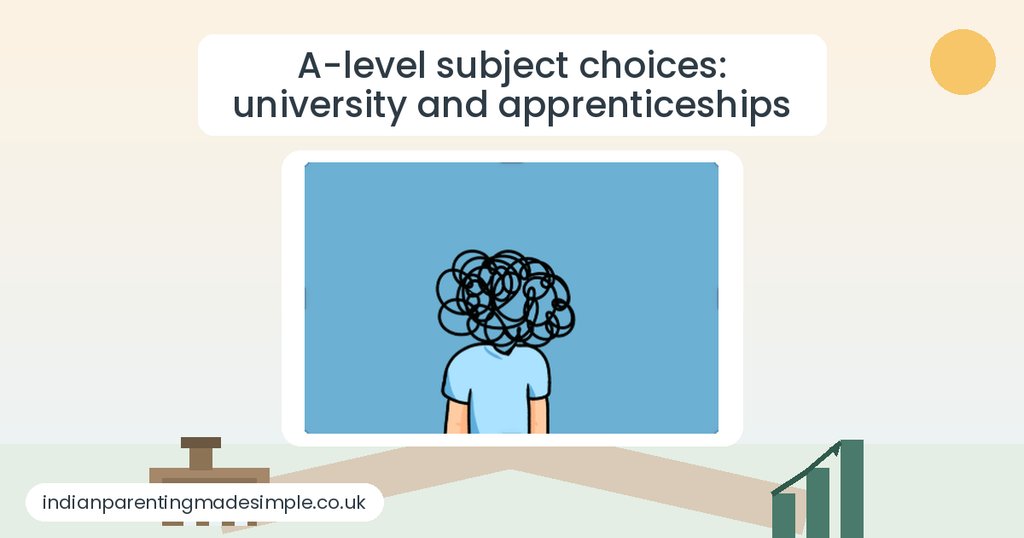
  • How A-Level Subject Choices Shape University and Degree Apprenticeship Options

    Illustration of a confused teen choosing between a university path and an apprenticeship path, representing A-level subject choices

    If your child has just started Year 12, you might already be lying awake over their A-level choices. You are nowhere near alone. A widely cited Which? University survey found that roughly one in three university applicants regretted their A-level subject choices. It’s from 2016, but the anxiety it captured hasn’t dated at all. Many wished they’d thought harder about how those choices would shape what came next.

    Here’s the reassuring part: in 2026, “what comes next” isn’t just university an more. Degree apprenticeships have changed the maths on this completely. They don’t always play by the same subject rules as a UCAS application. This guide walks through how A-level choices actually affect both routes — and what’s genuinely fixed versus flexible. It also answers the question underneath all the others: what to do if your child has already chosen “wrong.”

    This is a companion piece to our guide on starting sixth form. If you haven’t read that one yet, it covers the first-term basics. This one goes deeper — into the decision that quietly shapes everything after it: the subjects themselves.

    Why This Question Matters More Than It Used To

    A decade ago, “which A-levels” really meant “which A-levels will get you into a good university.” That’s no longer the whole picture. Degree apprenticeships have grown into a genuinely competitive alternative route, especially in finance, engineering, technology, and law. Here, a school leaver earns a full salary while an employer pays their tuition fees. They graduate debt-free, too — with both a degree and several years of work experience.

    The practical effect for parents: your child’s A-level subjects are now doing double duty. They need to keep the university door open, in case that’s the eventual choice. At the same time, those subjects need to make sense on an apprenticeship application. Employers often assess these differently — on UCAS points and general aptitude, rather than a specific subject list.

    Quick explainer if you haven’t met the term: UCAS points turn each qualification grade into a comparable number. (You might also see them called UCAS Tariff points.) So an offer might ask for “112 points” instead of naming exact grades. Understanding both systems at once is what makes this feel more complicated than it was for us growing up.

    The “Facilitating Subjects” Myth (and What Replaced It)

    A lot of the anxiety around A-level choice traces back to something that technically doesn’t exist any more. For years, the Russell Group published a list of “facilitating subjects.” These were traditional, essay- or maths-heavy A-levels — think Maths, the Sciences, English, History, and Languages. Schools and parents treated them as the safest route into a top university.

    The Russell Group scrapped that list in May 2019. Critics said it was quietly disadvantaging students who took vocational, creative, or less traditional combinations. People were also misreading it as “the only subjects worth taking.”

    The Russell Group replaced it with a free tool called Informed Choices. Enter the subjects your child is taking, or considering, and see which degree courses those subjects could realistically support. It’s genuinely useful for a five-minute gut-check. Just remember it’s a general guide, not a guarantee. Always cross-check against the specific university course page before ruling anything in or out.

    The takeaway for parents: if your child didn’t pick three “traditional academic” A-levels, that’s not automatically a problem. What matters far more is whether their combination lines up with the course or apprenticeship they’re aiming for. That’s a narrower, much less scary question.

    What Universities Actually Look For, by Course Type

    Requirements vary by university and even by year, so treat this as a starting orientation rather than gospel. Always confirm on the actual course page. But as a general pattern:

    Course typeWhat’s typically expected
    Medicine, Dentistry, Veterinary ScienceUsually Chemistry plus Biology, and often a third science or Maths — these tend to be the most fixed requirements of any course type.
    Engineering & Physical SciencesMaths is almost always required; Physics is required or strongly preferred for most Engineering courses.
    EconomicsMaths is frequently required or very strongly preferred, particularly at higher-tariff universities.
    Law, Humanities & Social SciencesNo fixed subject list at most universities. But essay-based subjects — History, English Literature, Politics, Sociology — help show the writing and argument skills these courses look for at interview and in personal statements.
    PsychologyVaries by university — some prefer a science (often Biology) or Maths, others don’t specify at all. Worth checking course-by-course.
    Art, Design & ArchitectureA relevant Art/Design A-level plus a portfolio typically matters more than the rest of the subject combination.

    What Degree Apprenticeship Employers Actually Look For

    This is where it gets genuinely different — and, in my experience, more reassuring than people expect. My own daughter is currently going through Finance Degree Apprenticeship applications for 2027 entry. The first thing that struck both of us: many employers assess on total UCAS points, not specific subjects. She’s also been using a couple of AI-powered prep platforms to get ready for the online assessments and interviews — more on those in the resources section below.

    A Few Real Examples (With a Big Caveat)

    HSBC’s banking degree apprenticeship, for example, asks for five GCSEs at grade 4+, including Maths and English, plus 96 UCAS points overall. It doesn’t dictate which three A-levels those points come from. Barclays’ apprenticeship route, by contrast, asks for three A-levels at grades BCC or equivalent.

    There’s a clear pattern across the finance sector: a total-points or overall-grade bar is far more common than a rigid “you must have taken X, Y and Z” requirement. (Figures via Prospects, the UK’s official graduate careers service — a good bookmark for checking other employers too.)

    A genuine caveat: requirements differ scheme by scheme and change from year to year. Treat the examples above as illustrations of the pattern, not as current figures to rely on. Before your child applies anywhere, check that employer’s own apprenticeship page for the live requirement. The UCAS apprenticeship search is a good starting point — but always trust the employer’s own page over any general guide, including this one.

    Why Timing Matters More Than the Deadline

    One more thing worth flagging while your child is still in Year 12 or 13. Degree apprenticeship applications — particularly in banking and finance — tend to open earliest, from around September. Many also run on a rolling basis. That means popular schemes close once enough strong applications come in, regardless of the advertised deadline. “I’ll apply nearer the closing date” is the single costliest mistake I’ve seen other families make with this route.

    Parent tip: List every prospective degree apprenticeship with your teen in a shared Google worksheet, noting the application start date and deadline for each. It’ll help you keep on top of the applications and stay organised.

    Two Routes, Two Timelines: How They Compare

    StageUniversity (UCAS) routeDegree apprenticeship route
    Applications open12 May 2026 (UCAS Hub); submit from 1 September 2026From around September 2026, varies by employer — finance/banking schemes tend to open earliest
    Key deadline15 Oct 2026 (Oxbridge, Medicine, Dentistry, Vet Science); 13 Jan 2027 (equal consideration, most courses)No fixed date — many schemes close early once filled, so early application matters more than the advertised deadline
    AssessmentPredicted grades, personal statement, sometimes an interview or admissions testOnline tests, video interview, and an assessment centre — typically Dec–Apr
    Offer typeConditional offer based on predicted/actual A-level gradesConditional job offer, often based on UCAS points rather than named grades
    ConfirmationA-level results day (mid-August 2027)Same results day — confirms both the degree place and the job start

    Dates above reflect the official UCAS 2027 entry timeline, current when we wrote this. Always confirm the latest dates on ucas.com nearer the time, since UCAS revises them occasionally.

    “Is It Too Late to Change A-Level Subjects?”

    If you’re reading this because your child has already started their A-levels and is having second thoughts, here’s the honest timeline:

    • Before term starts: the easiest possible time — most sixth forms will accommodate this without question.
    • During September: still generally fine at most colleges, but speak to the sixth form as soon as possible. The longer you wait, the harder it is to catch up on missed content.
    • After one term: possible in many cases if your child does independent catch-up work and the school agrees. But it needs a real conversation with their head of sixth form or subject teacher.
    • After a full year: generally not recommended. There usually isn’t enough time to learn Year 2 content from scratch while also revising for final exams.

    Every sixth form and college sets its own policy. So the single most useful thing you can do is ask directly and early — don’t assume it’s fixed, and don’t assume it’s easy. And take some pressure off yourself and your child: between the end of the “facilitating subjects” rule and how many apprenticeships assess on overall points, the rules have genuinely loosened. A single subject swap is rarely as make-or-break as it feels in the moment.

    A Checklist for Parents This Term

    1. Run your child’s current or planned subjects through Informed Choices to see which degree courses stay open — it takes five minutes.
    2. If they’re even loosely considering an apprenticeship, look up two or three specific schemes in that sector now, not next year. Note whether they quote UCAS points or named grades.
    3. Put the earliest known application-opening dates for those schemes in your calendar — aim to apply in the first few weeks, not the last.
    4. If a subject genuinely isn’t working, have the conversation with the sixth form this month, not at Easter.
    5. Keep a shared note of deadlines — UCAS and any apprenticeship schemes — somewhere you both check. A shared phone note or wall calendar works better than memory.

    Frequently Asked Questions

    Do Russell Group universities require specific A-level subjects?

    No fixed list any more. The Russell Group scrapped its “facilitating subjects” list in 2019 and now points students to its Informed Choices tool. The tool shows which courses a given subject combination could support. Specific courses — Medicine, Engineering, Economics — still have their own subject expectations. Those come from the individual course, not a universal Russell Group rule.

    Can you get a good degree apprenticeship without traditional academic A-levels?

    Often, yes. Many finance, technology, and engineering apprenticeship schemes assess against a total UCAS points threshold or an overall grade bar, not specific A-level subjects. So a broader subject mix can still meet the requirement. Always check the specific employer’s current listing, since this varies by scheme.

    Is it too late to change A-level subjects in Year 12?

    It depends on timing and your sixth form’s policy. Before or during September is usually straightforward. After one term it’s harder, but sometimes possible with catch-up work and school agreement. After a full year it’s generally not advisable. Ask the sixth form directly and as early as possible.

    Do apprenticeships accept UCAS points instead of specific grades?

    Many do. Some banking apprenticeship schemes, for example, ask for a total UCAS points figure — combining GCSEs and A-levels — rather than naming exact subjects or grades. That gives more flexibility than a fixed-grade university offer. Requirements still vary significantly by employer, so check each scheme individually.

    What’s the one thing to do this month if my child hasn’t decided their path yet?

    Run their current subjects through the Informed Choices tool and look up two or three apprenticeship schemes in a sector they’re curious about. Keeping both routes visible at once — rather than assuming it’s university or nothing — is the single biggest anxiety-reducer I’ve found.

    Resources Worth Bookmarking

    • Informed Choices — the Russell Group’s free tool for checking which degree courses a subject combination could open up.
    • UCAS: 2027 entry dates and deadlines — the official, regularly updated source for every UCAS deadline mentioned above.
    • UCAS apprenticeship search — browse live degree apprenticeship listings by sector.
    • The Apprentice Guide — AI mock interviews, CV and cover letter tools, and psychometric test practice. My daughter passed this along from her own applications. It’s a paid subscription after a free trial, so worth trying before you commit.
    • Apprentice Lab — another one my daughter’s been using: CV scoring, mock interviews, and deadline tracking for schemes at firms like Deloitte, PwC, and Goldman Sachs. £7.99/month after a 1-day free trial.
    • CBSE to GCSE Conversion Guide — if you’re newer to the UK system and want the earlier-stage picture first.
    • Choosing Your A Levels: and Other Academic Options by Cerys Evans — a deeper dive into subject choice if the Informed Choices tool leaves you wanting more.
    • Degree Apprenticeship Application Guide by Frances Trought — the most directly on-topic pick here if your child is seriously considering the apprenticeship route.
    • The Ultimate UCAS Personal Statement Guide by Rohan Agarwal & David Salt — worth bookmarking now, useful the moment personal statement season starts.

    However, this term is going for your family — confident, second-guessing, or somewhere in between — the subjects on that timetable are more flexible than they feel right now. Do the five-minute checks above, have the early conversation if you need one, and know that both doors — university and apprenticeship — stay open far longer than the sixth-form induction evening made it sound.

    — Tej

    As an Amazon Associate, I earn from qualifying purchases.

  • Sport and Teen Wellbeing: Why Team Sports Build Resilient Teens at Every Age

    Teen sports team huddled together, hands stacked — sport and teen wellbeing in action.

    Key Takeaways

    • Watching a resilient team performance with your teens can open up real conversations about trust, focus and not giving up — the same qualities they need for GCSEs and A-levels.
    • For 13–15 year olds, structured summer camps (football, tennis, cricket) build discipline and social confidence outside the classroom.
    • For 16–18 year olds, regular gym sessions or fitness routines support concentration, sleep and stress management during exam years.
    • Physical activity isn’t a distraction from study — it’s part of what makes sustained study possible.
    • One hour of outdoor activity on school days is a small ask with a big return.

    It Started With a World Cup 2026 Football Match on the Sofa

    Sport and teen wellbeing go hand in hand more often than we give them credit for — and some of the best parenting conversations happen by accident. Ours came from an England match that went right down to the wire against Norway in World Cup 2026 — missed chances, a nervy late foul, a goalkeeper having the game of his life, and a moment of brilliance from Bellingham that settled it.

    My husband, our teenagers and I were glued to the screen. But what stayed with me afterwards wasn’t the scoreline — it was watching my daughters notice things: players trusting each other under pressure, staying focused when it would have been easier to switch off, and delivering when it mattered most, even after a long, tiring game in punishing heat.

    That’s not just sport. That’s the exact skill set we spend years trying to teach through school — and it turns out the pitch teaches it faster than the classroom sometimes does.

    Why Sport and Teen Wellbeing Are More Connected Than You’d Think

    Team sport gives teens something exam pressure rarely does: an immediate, visible feedback loop for resilience. Miss a chance, get back into position. Concede a goal, stay switched on for the next ninety minutes anyway. Teens absorb this far more naturally through play than through a pep talk from a parent.

    For Indian families in the UK, where academic pressure often (understandably) dominates the conversation at home, sport offers a low-stakes way to practise:

    • Handling setbacks without it feeling like a “failure” in the way a bad mock exam does
    • Working within a team, which mirrors group projects and later, workplace collaboration
    • Physical confidence, which quietly supports mental confidence in unrelated areas like presentations or interviews
    • Switching off from screens and revision, which every parent of a GCSE or A-level student knows is half the battle

    What This Actually Looks Like by Age

    The right kind of activity — and the right amount of structure — genuinely differs between a 13 year old and a 17 year old. Here’s a simple way to think about it.

    Ages 13–15: Summer Camps Over Solo Screen Time

    This age group benefits most from structured, sociable activity — a tennis or football summer camp does more for a young teen than an unstructured “go outside and play” instruction ever will. Camps give:

    • A routine that mimics the discipline of a school day, without the school-day pressure
    • New friendships outside their existing school circle
    • A coach’s feedback, which teens often accept more easily from a non-parent
    • A natural, screen-free break before GCSE years ramp up

    If your teen has shown any interest in a sport — even a passing one — a one or two-week camp in the summer holidays is one of the lowest-effort, highest-return bookings a parent can make. The same principle applies beyond the pitch: structured, hands-on enrichment like coding and STEM workshops builds the same discipline and confidence for teens who aren’t sporty.

    Ages 16–18: Gym and Personal Fitness Routines

    By 16, most teens want more independence, and this is where a gym membership or a simple home fitness routine tends to work better than a team camp. This age group is usually juggling GCSE results, A-level workload, and early thoughts about university or degree apprenticeships — so the goal shifts slightly:

    • Fitness becomes a stress-management tool, not just a physical one.
    • A regular gym slot (even 3 times a week) creates a consistent break in an otherwise packed revision timetable.
    • It supports better sleep, which has a far bigger impact on exam performance than most parents realise.
    • It gives older teens something that’s entirely theirs — not school, not family, not exams.

    The Focus Connection Parents Often Miss

    There’s a reason schools that protect PE time and outdoor breaks tend to see better concentration in class, not worse. Physical activity regulates mood and energy in a way that pure study time cannot. A teen who has spent an hour running around a pitch or training at the gym typically comes back to their desk more focused, not less — even though it feels, on paper, like “time lost” to revision.

    If your household is anything like ours, protecting that hour of activity on a school day is one of the simplest, least expensive interventions you can make for both sport and teen wellbeing — and it pairs well with the pastoral side of school transitions too. If you’re also navigating the shift from CBSE, our guide on moving from CBSE to GCSE Year 9 UK covers how wellbeing fits alongside the academic adjustment.

    A Small Ask With a Big Return

    None of this requires turning your teen into an athlete. It’s about treating sport and teen wellbeing as genuinely connected — not an optional extra once the “real work” of studying is done. Whether it’s a summer camp booking for your 14 year old or encouraging your 17 year old to commit to three gym sessions a week, you’re building the same resilience, focus and self-belief that a team of eleven can show you in ninety minutes on a pitch.

    If community and belonging are also part of what you’re settling in for, our guide to moving to the UK from India with teens touches on how volunteering and local activity build the same sense of belonging that team sport does.


    Have you noticed a difference in your teen’s focus or mood on the days they’re active? I’d love to hear how sport fits into your family’s routine — drop a comment or join the conversation on r/ParentingIndianTeenUK.

  • My Teen Struggled at GCSE — Then Everything Changed

    Teen studying for AS level exams with revision notes and calculator on desk.

    Quick Summary:

    Many Indian parents worry when their teenager seems unfocused during GCSEs. This post shares one parent’s experience of watching their daughter struggle at GCSE level, then completely transform her work ethic and drive by Sixth Form. It explores why the GCSE-to-Sixth Form transition can be a turning point, what Indian parents can do to support without adding pressure, and why some teens simply need more time to find their motivation.

    When Your Teen’s GCSE Years Don’t Go to Plan

    If you are an Indian parent watching your teenager drift through their GCSE years without much focus or drive, I want you to read this.

    Because I was you. Not long ago.

    My elder daughter gave me sleepless nights during her GCSEs. She wasn’t failing, but she wasn’t really trying either. The focus wasn’t there. The urgency wasn’t there. Every conversation about revision felt like pulling teeth, and I spent more time worrying than she spent studying.

    As an Indian parent, you know how that feels. We carry the weight of their future on our shoulders sometimes more than they do.

    But then something shifted. By the time she reached Sixth Form and started her AS levels, I barely recognised the same girl. She was up early. She had a revision schedule she had made herself. She was strict with her own time, removed her own distractions, and had a clear vision of what grades she wanted and why.

    No nagging from me. No reminders. She had found her own drive.

    And I had to ask myself — what changed?


    Why Some Teens Don’t Click at GCSE Level

    GCSEs are sat at 15 and 16. Developmentally, that is a young age to have genuine intrinsic motivation around academic performance. Many teenagers — particularly bright ones — coast through this stage because they can. The content feels manageable without real effort, and the consequences of not trying don’t feel real yet.

    For Indian parents who pushed hard at this stage in their own schooling or watched siblings excel, this coasting can feel alarming. We interpret lack of effort as lack of ambition. But sometimes it is simply lack of readiness.

    A few things that can hold a teen back at GCSE:

    • They haven’t connected their studies to anything they actually care about yet
    • The pressure from home has made revision feel like something imposed rather than chosen
    • Social life and identity feel far more urgent at 15 than exam grades
    • They haven’t yet experienced a consequence significant enough to motivate change

    None of these mean your teen is heading in the wrong direction. They may simply not be ready yet.


    What the GCSE to Sixth Form Shift Actually Does

    Sixth Form is different in a way that surprises many parents. The shift from compulsory subjects to chosen ones is more powerful than it sounds.

    When your teen chooses their A-Level subjects, they are — often for the first time — studying things they have actively opted into. The autonomy changes everything. Suddenly revision doesn’t feel like a chore someone else cares about. It feels like investment in something they chose.

    Add to this the fact that university applications and career paths start becoming real and visible in Sixth Form in a way they simply aren’t at 15, and many teenagers undergo a significant shift in their relationship with studying.

    My daughter is proof of that. The girl who couldn’t find motivation for her GCSEs is now the one telling me she needs quiet time to revise.


    What I Did Differently (And What I Wish I’d Done Earlier)

    Looking back, here is what I think helped — and what I wish I had done during the GCSE years:

    1. Backed off the pressure, just a little
    The more I pushed during GCSEs, the more she dug her heels in. Easing off didn’t mean I stopped caring — it meant I stopped making every conversation about revision.

    2. Kept the relationship warm
    When teens feel like you only talk to them about school, they shut down. Keeping connection alive — watching something together, cooking together, just chatting — meant she still came to me when things got hard.

    3. Let her feel a consequence
    I won’t lie — a set of GCSE results that weren’t what she hoped for was a turning point. She needed to feel the gap between effort and outcome herself. I couldn’t feel it for her.

    4. Trusted the timeline
    This is the hard one. Indian parenting culture doesn’t do well with waiting. But some teens arrive later, and arriving later doesn’t mean arriving wrong.


    For the Indian Parent Who Is Worried Right Now

    If your teen is in Year 10 or 11 and you feel like you are watching them sleepwalk through the most important exams of their life so far — I see you.

    Keep the lines of communication open. Keep the relationship warm. Make sure they have what they need practically — a good study space, the right revision materials, access to support if they are struggling.

    And then, as hard as it is, trust them a little.

    The transformation can come. It came for my daughter. It comes for many teens who seemed lost at 15 and found themselves completely by 17.

    You are not failing as a parent. You are just in the waiting room.


    Useful Resources


    Are you going through this with your teen right now? Or have you come out the other side? Share your experience in the comments.

    You could even share your thoughts and experiences by joining ParentingIndianTeenUK Reddit Community.

  • How to Motivate a Teenager to Study (Backed by Psychology + Real Parent Strategies)

    Teenager studying with books and motivational tiles spelling You Got This — tips for parents on how to motivate a teenager to study

    If you’ve ever said:
    “Just sit down and study!”
    …and your teenager still doesn’t, you’re not alone.

    For many Indian parents—especially in the UK—education is deeply valued. We grew up believing that hard work and discipline lead to success. So when our teenagers seem unmotivated, it can feel frustrating, even worrying.

    But here’s the truth:

    👉 Motivation isn’t created by pressure—it’s created by the right environment.

    Most parents believe motivation comes from discipline, pressure, or fear of consequences. But decades of psychological research show the opposite:

    Teen motivation is driven by three core needs — autonomy, competence, and connection.

    When these needs are not met, teenagers don’t become lazy — they become disengaged.

    This is especially relevant in Indian households, where high expectations are common, but emotional support and independence are often unintentionally limited.


    Why Teenagers Lose Motivation (What Research Actually Says)

    Motivation tends to drop during adolescence—not because children become lazy, but because their psychological needs change.

    According to Self-Determination Theory, motivation is driven by three core needs:

    • Autonomy – feeling in control
    • Competence – believing “I can do this”
    • Relatedness – feeling supported

    A large meta-analysis of over 144 studies found that when these needs are met, students show significantly higher academic engagement and achievement.
    (Source: https://journals.sagepub.com/doi/10.3102/00346543211042426)

    Research in adolescent psychology shows that motivation drops when teenagers feel controlled rather than supported.

    The 2021 study on student motivation found that autonomy-supportive parenting significantly increases academic engagement, while controlling environments reduce intrinsic motivation and increase resistance.

    In simple terms:

    • The more a teen feels “forced,” the less they want to try
    • The more they feel “in control,” the more effort they put in

    This explains why constant reminders, comparisons, or pressure often backfire — especially in high-expectation cultures like Indian families.


    The Indian Parenting Reality (That No One Talks About)

    In many Indian households, motivation is often shaped by:

    • High academic expectations
    • Comparison with peers (“neighbours’ son or daughter…”)
    • Focus on stable careers (medicine, engineering, finance)
    • Respect for authority (parents know best)

    While these come from a place of care, they can sometimes:

    • Reduce autonomy
    • Increase pressure
    • Create fear of failure

    👉 The result? A teenager who looks “lazy” but is actually overwhelmed.


    7 Proven Ways to Motivate Your Teenager (That Actually Work)

    1. Start with Conversation, Not Control

    Instead of:
    “Go and study now”

    Try:

    • “What’s feeling difficult right now?”
    • “How can I help you get started?”

    Research shows that autonomy-supportive parenting improves motivation and engagement.
    (Source: https://journals.sagepub.com/doi/10.3102/00346543211042426)


    2. Help Them Find Their “Why”

    Teenagers don’t respond to:
    👉 “Because I said so”

    They respond to:
    👉 “This is how it connects to your future”

    Example:

    • Maths → careers in finance, data, tech
    • Science → medicine, research

    👉 Motivation increases when learning feels meaningful.


    3. Reduce Comparison (This Is Big in Indian Homes)

    Comparison may create short-term pressure, but it damages long-term motivation.

    Instead of:
    “Look at your cousin…”

    Say:
    “Let’s focus on your progress”

    In many Indian households, comparison is used as a motivational tool:
    “Look at Sharma ji’s son…”

    While this may create short-term action, research shows it often leads to:

    • Lower self-esteem
    • Increased anxiety
    • Reduced long-term motivation

    Teenagers begin to associate studying with fear and inadequacy, not growth.

    A better shift is:
    👉 From comparison → to personal progress

    Instead of asking:
    “Why can’t you be like them?”

    Ask:
    “What’s one small thing you can improve today?”


    4. Give Them Ownership

    Instead of creating a strict timetable:

    • Let them decide:
      • When to study
      • How to revise
    • Agree on outcomes, not methods

    Research shows that self-directed learning improves motivation patterns in adolescents.
    (Source: https://pubmed.ncbi.nlm.nih.gov/25073077/)


    5. Break Work Into Small Wins

    “Revise everything” = overwhelming
    “Do 5 questions” = doable

    Small wins:

    • Build confidence
    • Reduce procrastination
    • Increase consistency

    6. Manage Screen Time Without Constant Conflict

    Phones are often the biggest battle.

    Instead of banning:

    • Agree on:
      • 30–45 min focused sessions
      • Breaks as rewards

    👉 Collaboration works better than control.


    7. Look Beyond “Laziness”

    Sometimes, lack of motivation is actually:

    • Anxiety
    • Burnout
    • Fear of failure

    Research shows that when psychological needs are frustrated, engagement drops significantly.
    (Source: https://journals.sagepub.com/doi/10.1177/0890207020962330)

    👉 The solution isn’t pressure—it’s support.

    Studies on adolescent behaviour consistently show that parental involvement — when supportive rather than controlling — has a measurable positive impact on academic outcomes.

    For example, research involving secondary school students found that structured guidance, emotional support, and clear expectations improved both motivation and consistency in study habits.

    This reinforces a key idea:
    👉 Teenagers don’t need more pressure — they need better support systems.


    Real-Life Scenario (Indian Parent Context)

    A parent in London shared:

    “My daughter wasn’t studying at all before her GCSE mocks. I kept reminding her daily. It only made things worse.”

    What changed?

    • They stopped daily reminders
    • Had one calm conversation
    • Agreed on 3 small goals per day

    Within 2 weeks:

    • Study time improved
    • Arguments reduced
    • Confidence increased

    👉 The shift was simple: from control → support


    The Indian Parent Motivation Shift

    Most parents unknowingly follow this pattern:

    • Pressure → Short-term results
    • Control → Resistance
    • Comparison → Self-doubt

    But long-term motivation comes from a different approach:

    • Support → Confidence
    • Autonomy → Ownership
    • Connection → Consistency

    Motivation doesn’t come from pushing harder.
    It comes from changing how your teenager experiences learning.

    For example, a parent preparing their child for GCSEs noticed constant arguments about studying.

    Instead of increasing pressure, they changed approach:

    • Reduced daily nagging
    • Agreed on small, achievable study goals
    • Spent 10 minutes daily just talking — not about studies

    Within weeks, the teenager became more consistent — not because of pressure, but because they felt more in control.

    This is a common pattern:
    👉 When resistance drops, effort increases.

    Common Mistakes Indian Parents Make

    • Constant reminders (“Have you studied?”)
    • Comparing with relatives or friends
    • Linking self-worth to grades
    • Over-scheduling tuition + school + homework

    👉 These reduce intrinsic motivation over time.


    Quick Action Plan (Start This Week)

    • Have one calm, non-judgemental conversation
    • Help your teen set 3 small daily goals
    • Focus on effort, not just results
    • Reduce pressure, increase encouragement

    FAQs (Optimised for Google + AI)

    Why is my teenager not motivated to study?
    Often due to lack of autonomy, confidence, or feeling overwhelmed—not laziness.

    Does pressure help teenagers study?
    No. Studies on adolescent motivation show that controlling environments reduce intrinsic motivation, while autonomy-supportive parenting increases engagement and persistence (Bureau et al., 2021).

    What motivates teenagers the most?
    Autonomy, competence, and supportive relationships.


    References


    Final Thought

    As Indian parents, we care deeply about our children’s future.

    But the most powerful shift we can make is this:

    👉 Move from “pushing harder” → “understanding better”

    Because when teenagers feel supported, capable, and in control—
    they don’t need to be forced to study.

    They choose to.

    If there’s one thing to remember, it’s this:

    Your teenager is not unmotivated — they are reacting to their environment.

    When you shift:

    • From pressure → to partnership
    • From control → to guidance
    • From comparison → to understanding

    You don’t just improve their studies — you strengthen your relationship with them.

    And that is what truly drives long-term success.

  • Why Teenagers Give One-Word Answers: The Science Behind the Silence

    Collage showing the word why in yellow Scrabble tiles, the word silence under a magnifying glass, and a parent in conversation with their teenager — illustrating the psychology behind teenage silence and withdrawal

    Understanding why your teenager goes quiet is the first step to responding in a way that actually helps — rather than pushing them further away.

    The Teenage Brain Is Under Renovation

    Dr. Frances Jensen, neurologist, neuroscientist, and former Chair of the Department of Neurology at the University of Pennsylvania’s Perelman School of Medicine, has spent decades studying the adolescent brain. Her research, summarised in The Teenage Brain: A Neuroscientist’s Survival Guide to Raising Adolescents and Young Adults, reveals something that changes everything about how we interpret teenage behaviour.

    The prefrontal cortex — the part of the brain responsible for decision-making, impulse control, planning, and crucially, emotional regulation — is the last part of the brain to fully mature. This process continues well into the mid-twenties. As Jensen explains, it is not that teenagers do not have frontal lobe capabilities — it is that the signals are not getting to the back of the brain fast enough to regulate their emotions efficiently.

    What this means in practice: your teenager is working with an underdeveloped emotional regulation system, 24 hours a day, seven days a week. By the time they walk through your front door at the end of a school day, they are often genuinely depleted — not sulking, not punishing you, but running on empty.

    A one-word answer is frequently not “I don’t want to talk to you.” It is “I have nothing left.”

    Verbal Communication Requires Cognitive Energy

    Dr. Lisa Damour, clinical psychologist and New York Times bestselling author of Untangled, Under Pressure, and The Emotional Lives of Teenagers, describes something that resonates deeply with parents once they hear it.

    Teenagers, she explains, are working intensely hard at the task of adolescence: building their identity, navigating complex peer relationships, managing academic pressure, and — critically — beginning the process of psychological separation from their parents. This is developmentally necessary, not a sign that something has gone wrong.

    As Damour puts it: teenagers have to become increasingly independent while still living under your roof. In order to do that, they withdraw. The withdrawal is not rejection — it is the mechanism through which they achieve the psychological independence they need.

    In other words, your teenager going quiet is, in part, a sign of healthy development. It does not always feel that way. But understanding it changes how you respond.

    Overwhelm Shuts Down Language First

    Research published in the Journal of Adolescence and supported by studies from institutions including Indiana University and Duke University has found that adolescent social withdrawal is closely linked to emotional overwhelm. When teenagers are under significant cognitive or emotional load, the systems that support articulate communication are often the first to go offline.

    Think of it like a computer with too many programmes running at once. The processor does not stop working — it just stops responding to requests that are not urgent. For a teenager carrying the weight of social dynamics, exam pressure, identity questions, and the physical changes of adolescence, a question about their day can feel like one more demand on an already overloaded system.


    Is This Normal, or Should I Be Worried?

    This is the question every parent asks — and it is the right one.

    There is an important difference between a teenager who is temporarily depleted and naturally more private, and one who is withdrawing as a symptom of something more serious.

    Typical teenage withdrawal looks like:

    • Going quiet after school or after socially intensive days
    • Being monosyllabic at dinner but more talkative later in the evening
    • Preferring to be in their room but coming out for meals, family moments, and things they enjoy
    • Showing warmth in small ways even when not communicating verbally
    • Their mood lifting after rest, food, or time with friends

    Signs that may warrant a closer look:

    • Withdrawal that is persistent across all contexts, not just home
    • Loss of interest in things they previously enjoyed
    • Changes in sleep, appetite, or school attendance
    • Pulling away from friends as well as family
    • Any mention of hopelessness, worthlessness, or not wanting to be here

    If you are seeing a cluster of the second type of signs, it is worth having a gentle, direct conversation — and seeking support from their GP or a qualified professional if needed. As Dr. Damour emphasises, mental health in teenagers is not about the absence of distress; it is about having appropriate support for navigating it.


    What Actually Works When Your Teenager Goes Quiet

    Now we get to the practical part. Because knowing why your teenager is giving one-word answers is only half the picture. The other half is knowing what to do about it.

    1. Go Low-Pressure, Not High-Pressure

    The instinct when someone withdraws is to pursue. We ask more questions, probe deeper, sit them down for a conversation. With teenagers, this almost always produces the opposite of what we want.

    When your teenager is in a depleted state, a direct question about their feelings or their day activates the very system — the prefrontal cortex — that is already running low. It feels like a demand. It often produces defensiveness or further shutdown.

    Instead: lower the ask. A casual comment — “I made your favourite for dinner” — requires nothing from them. A side-by-side activity — watching something together, driving somewhere, sitting in the same room doing different things — maintains connection without demand. You are communicating: I am here. You do not have to perform for me.

    2. Try Side-by-Side Connection

    This is one of the most research-backed insights in adolescent communication, and one of the most underused by parents.

    Face-to-face conversation — the classic “let’s sit down and talk” — is actually a high-stakes format for teenagers. Direct eye contact, full attention, the expectation of verbal response: for a depleted adolescent, this can feel genuinely threatening.

    Side-by-side connection removes those pressures. Car journeys are famous among therapists who work with teenagers for being unexpectedly productive conversations — the absence of eye contact, the shared direction of travel, the natural rhythm of a drive all create conditions where teenagers are far more likely to open up than they would across a kitchen table.

    The same is true of walks, cooking together, watching a series, or even sitting in the same room doing separate things. You are not interrogating them. You are just… there. And “just being there” communicates safety in a way that direct questioning often cannot.

    3. Time Your Conversations Better

    Most parents try to connect with their teenagers at the worst possible time: immediately after school, just before bed, or in the middle of homework. These are moments of peak cognitive load or exhaustion — the exact circumstances least conducive to open conversation.

    Observation is your best tool here. Watch your teenager. When are they naturally more talkative? When do they seek you out? For many teenagers, it is later in the evening — the classic “midnight confession” phenomenon that parents of older teens will recognise. For others it is weekend mornings, or after exercise, or during specific activities.

    Find their window. Show up in it without agenda. Let them lead.

    4. Ask Better Questions

    “How was your day?” is a closed question that virtually demands a one-word answer. Its design is its problem.

    Teenagers respond significantly better to questions that are specific, low-stakes, and that invite opinion rather than report. Compare:

    • “How was school?” vs “What was the most boring part of today?”
    • “Are you okay?” vs “You seem tired — do you need anything?”
    • “Why won’t you talk to me?” vs “I’m around if you want company.”

    The second version of each question does not demand an account. It opens a door without requiring them to walk through it. That distinction matters enormously to a teenager who is already feeling overwhelmed.

    5. Stay Connected in Small Ways

    Big conversations are not the only way to maintain a relationship with your teenager. In fact, during the years when big conversations feel impossible, small moments of consistent warmth often do more relational work than any sit-down discussion.

    A snack left outside their door. A text with a funny video about something you know they like. Asking for their opinion on something genuinely trivial. Saying “I love you” without expecting a response. Noticing something they did and mentioning it without making it a lesson.

    None of these require them to perform openness. All of them deposit into the relational account — so that when they are ready to talk, the connection is still there.

    6. Be the Safe Landing Place

    One of the most important things Dr. Damour says about teenagers and communication is this: they do not need parents who react perfectly every time. They need parents who are predictably safe.

    What that means in practice: when they do come to you — with something small, or something big — your reaction in that moment teaches them whether it is safe to come again. If the response to a small disclosure is worry, interrogation, or unsolicited advice, the door quietly closes. If the response is calm, interested, and non-reactive, the door opens wider.

    You do not have to do this perfectly. But being aware of it — and consciously trying to respond with calm curiosity rather than alarm — builds the kind of trust that makes the big conversations possible when they matter most.


    A Note for Indian Parents Specifically

    If you are an Indian parent raising a teenager in the UK, this dynamic can carry an additional layer of complexity.

    Many of us grew up in households where emotional expression was not particularly modelled or encouraged. We were raised with high standards, clear expectations, and love that was expressed through provision and sacrifice rather than words. That is a beautiful kind of love — and it is genuinely meaningful.

    But our teenagers are growing up differently. They are navigating an environment where emotional literacy is increasingly expected — by their schools, their peers, and eventually their workplaces. The one-word answer may sometimes be a reflection of not quite having the words for what they are feeling — not because they do not feel things deeply, but because nobody has ever asked them to put feelings into words before.

    The bridge we build with our teenagers — slowly, imperfectly, through all the small moments described above — is not a betrayal of our cultural values. It is an adaptation. We are not becoming less Indian by learning to ask different questions. We are becoming parents who can reach their children in the world they actually live in.


    Books That Go Deeper on This Topic

    If this resonates and you want to go further, these books — all available on Amazon UK — are worth your time:

    1. The Emotional Lives of Teenagers by Dr. Lisa Damour The most practically useful book on the market right now for parents trying to understand and support their teenager’s emotional world. Research-backed, warm, and full of real examples. Highly recommended.

    2. The Teenage Brain by Dr. Frances E. Jensen The neuroscience of adolescence made accessible. Understanding why the teenage brain works the way it does fundamentally changes how you respond to teenage behaviour.

    3. Untangled (Revised Edition) by Dr. Lisa Damour Now updated with new material on social media and post-pandemic adolescence. The original remains a classic.

    4. How to Talk So Teens Will Listen by Adele Faber & Elaine Mazlish A practical, conversation-focused guide for parents who want specific scripts and strategies. Different in tone to Damour but highly complementary.


    Related Reading on Indian Parenting Made Simple

    If this post resonated with you, you might also find these helpful:


    The Bottom Line

    Your teenager giving one-word answers is rarely about you. It is about a brain that is under construction, navigating more than you can see, running on resources that are genuinely limited.

    The parents who break through are not the ones who push harder. They are the ones who show up consistently, lower the pressure, and stay warm even when the door seems closed.

    Keep showing up. The conversations will come.


    Tej is the founder of Indian Parenting Made Simple, a blog for Indian parents raising teenagers in the UK. She writes about teen communication, school transitions, and the particular joys and challenges of parenting between two cultures.

    Follow @indianparentingmadesimple on Instagram for tips.


    References & Sources

    • Jensen, F.E. & Nutt, A.E. (2015). The Teenage Brain: A Neuroscientist’s Survival Guide to Raising Adolescents and Young Adults. HarperCollins.
    • Damour, L. (2016). Untangled: Guiding Teenage Girls Through the Seven Transitions into Adulthood. Ballantine Books.
    • Damour, L. (2023). The Emotional Lives of Teenagers. Ebury Publishing.
    • Casey, B.J. (2022). What neuroscience tells us about the teenage brain. American Psychological Association Monitor on Psychology. apa.org
    • Stamoulis, C. et al. (2025). Neural correlates of social withdrawal and preference for solitude in adolescence. Cerebral Cortex. Boston Children’s Hospital / National Science Foundation.
    • Harrist, A. et al. (2020). Adolescent social withdrawal, parental psychological control, and parental knowledge across seven years: A developmental cascade model. Journal of Adolescence. PMC7441827.
    • TIME Magazine (2017). Why teenage brains are so hard to understand. time.com

  • How to Discipline yet Stay Close to Your Teen Without Losing Your Authority

    Mum discussing boundaries with her teen daughter — navigating teen discipline while staying close

    Let me be honest with you. There have been evenings when I’ve completely lost my cool. A sharp tone, an eye-roll, a slammed door — and me standing in the hallway wondering where my warm, chatty child went. If that sounds familiar, you are in very good company.

    The teenage years have a way of testing everything you thought you knew about parenting. But here’s what the research — and real lived experience — keeps showing us: the goal isn’t to choose between being firm and being close. The goal is to be both, at the same time. That’s harder than it sounds. And it’s the most important parenting skill of this decade.

    Whether your teen is 13 or 17, whether you’re raising boys or girls, whether you’ve just moved to the UK or you’ve been here for years — the fundamentals of connecting with a teenager are universal. This post is for every parent who wants to stop feeling like they’re losing ground, and start building something real.

    Why 2026 Parenting Is All About Connection First

    The loudest conversation in parenting right now isn’t about grades or screen time (though those matter). It’s about the relationship itself. Experts and parents alike are waking up to the fact that you cannot discipline a teenager you’ve lost your connection with. The rules only work when the relationship is solid.

    The trend moving through 2025 into 2026 is what researchers call authoritative parenting — not authoritarian (my way or the highway), and not permissive (anything goes). Authoritative means warm AND firm. Clear boundaries AND genuine conversations. Love that doesn’t waver even when you’re furious.

    “The most admired parents in 2026 aren’t those who never fail. They’re those who commit to evolving, learning, and showing up fully for the human beings in their care.”— Parenting Trends 2026

    Another growing concept is Lighthouse Parenting — the idea that your job is to be a steady light your teen can navigate by, not a helicopter hovering over every move. You don’t shield them from every wave. You stand firm on the rock and let them know where home is.

    Building the Relationship: The Non-Negotiables

    1. Small moments beat big conversations

    You don’t build trust with your teenager through one dramatic heart-to-heart. You build it in the car on the way to school, over breakfast, in the 10 minutes before they disappear into their room. Be present in those pockets. Put your phone down. Ask about something you know they care about — not their homework.

    Try This

    Psychologist Dr. Daniel Amen’s “20-Minute Rule”: spend 20 unstructured minutes a day with your teen doing something they enjoy. No questions, no instructions, no agenda. Just be there. Listen more than you talk. What you learn will transform how you parent them.

    2. Lead by example — they are watching everything

    Teenagers are brilliant at spotting the gap between what you say and what you do. If you want them to serve others, let them see you serve. If you want them to keep going when things are hard, let them see your resilience. In our family, volunteering at church events, pitching in with the choir, helping behind the scenes — these aren’t just “nice things to do.” They are the lesson. Your teens absorb your character far more than your instructions.

    If you’re looking to build this kind of values-led family culture, the post on 2026 Vision Board Ideas for Teens & Parents is a great place to start the conversation together.

    3. Show your tender side — without losing your backbone

    One of the most powerful things a parent can do is say: “I got that wrong. I’m sorry.” Owning your mistakes doesn’t undermine your authority — it models the very thing you’re trying to grow in your teen. Repair matters. It teaches them that relationships can survive rupture, and that accountability isn’t humiliation.

    This doesn’t mean becoming your teen’s best friend. You can be warm, funny, present, and emotionally honest — and still be the parent who holds the line.

    Tackling Disobedience, Back-Chat & Disrespect

    Let’s talk about the stuff that actually makes your blood pressure spike. The eye-rolls. The “you don’t understand anything.” The homework they promised they’d done. The door slammed so hard the pictures rattled. What do the best psychologists actually say about this?

    Understand the brain before you react

    Here’s the most useful reframe: your teenager’s brain is literally under construction. The prefrontal cortex — the part responsible for impulse control, reasoning, and empathy — doesn’t fully develop until the mid-twenties. This isn’t an excuse for bad behaviour. But it is important context. When your teen overreacts, they are often not being manipulative — they are being overwhelmed. Knowing this can help you pause before escalating.

    On back-chat and disrespect

    Don’t try to out-argue a teenager in the heat of the moment. You will not win, and the relationship takes the hit. Instead, name what you see: “I’m not going to continue this conversation while we’re both this heated. We’ll come back to it in an hour.” Then follow through. Calmly. The follow-through is everything.

    When things are calmer, address the behaviour directly: “When you spoke to me like that, it was disrespectful. That’s not okay in this house.” Short. Clear. No lecture. Then move on. Teens tune out the moment you repeat yourself.

    Consequences vs. punishment

    Leading psychologists draw a clear distinction between punishment (something unpleasant you inflict) and consequences (a natural or logical result of a choice). The latter is far more effective with teenagers because it makes them think rather than just react. “You came home two hours late, so this weekend you stay in” is a consequence. It’s connected, proportional, and doesn’t require you to be the villain.

    Psychologist-Backed Tip

    Dr. Becky Kennedy (author of Good Inside) teaches a powerful concept: separate the behaviour from the person. “You are a good kid who made a poor choice” keeps the relationship intact while holding the line. Avoid global labels (“you’re so lazy,” “you never listen”) — they stick in ways you don’t want.

    Minimising Negative Outside Influence

    Peer pressure. Social media. The friend group you’re not sure about. If you’re navigating this in the UK, you’re also dealing with a social landscape that may feel very different from where you grew up. How do you keep your teenager anchored?

    The research is consistent: teens with a strong home base are more resistant to negative outside influence. Not because they’re sheltered, but because they have somewhere they feel genuinely known and valued. The connection you build at home is your teenager’s buffer against the world.

    That said, outright banning friendships or phones rarely works. Instead:

    • Know their world. Ask about their friends — not to interrogate, but to show genuine interest. If you know the names, you’re on the map.
    • Create a home teens want to come back to. That means physical space, food, and most importantly, feeling heard without being judged.
    • Give them community with purpose. Volunteering, church activities, sports clubs, creative groups — spaces where they are valued for what they give, not just how they look online.
    • Talk about digital life openly. Not as a lecture. Ask what they’re watching, what their friends are doing online. Stay curious, not suspicious.

    If your teenager is navigating a new culture on top of all this — which many of our readers are — the post on how to bridge the culture gap with your UK teen is worth reading together.

    Building Skills That Actually Matter: Communication, Resilience & Responsibility

    One of the most powerful things you can do for your teenager right now isn’t academic. It’s helping them build the ability to talk to people, navigate conflict, and take ownership of their life.

    Communication skills start at your dinner table

    Ask open questions. Debate ideas. Let them disagree with you — respectfully — and model how to do that without it becoming a fight. The teens who know how to have a proper conversation will stand out in job interviews, friendships, and every relationship they’ll ever have. This is the skill that compounds.

    Responsibility doesn’t come from nagging

    It comes from ownership. Give your teenager real responsibilities around the home and in the community — not as chores to be checked off, but as genuine contributions. Let them feel that they matter to the household. When something goes wrong because of their choices, resist the urge to rescue. The stumble is where the growth happens.

    If your teen is approaching GCSEs and feeling the pressure, our free GCSE Success Toolkit has practical tools to help them take charge of their revision rather than feeling paralysed by it.

    Family Time That Doesn’t Fall Flat

    Game nights. Sunday dinners. Volunteering together. Days out. These aren’t just nice-to-haves — they are the infrastructure of your relationship with your teenager. The moments where phones go down and you’re just… together.

    Here are some ideas that actually work with teenagers (i.e., they won’t immediately roll their eyes):

    🎲

    Game Nights

    Strategy games, trivia, even card games. Teenagers love to win, and a genuine game night levels the playing field. Let them choose the game. Let them trash-talk. Laugh together.

    🍳

    Cook Together

    Put them in charge of a dish once a week. It builds independence, creates space to talk, and — bonus — means you’re not doing all the cooking. Make it their recipe to own.

    🌍

    Day Trips & Exploring

    A coastal town, a market, a new part of London. Teens open up when they’re moving. Some of the best conversations happen in the car, away from the usual setting.

    🤝

    Volunteer Together

    Whether it’s a Holiday Club, food bank, or community event — doing something for others shifts the focus outward. It builds gratitude, belonging, and quiet confidence. And they’ll remember it long after they’ve forgotten your lectures.

    The 2026 parenting trend of “going analogue” — board games, landline-style communication, screen-free evenings — isn’t nostalgia. It’s a deliberate choice to create space for real connection. And it works. The families leaning into it are reporting something remarkable: their teenagers are joining in willingly, because they’re hungry for it too.

    Two Books Every Parent of a Teenager Should Read

    I don’t recommend books lightly, and I especially don’t recommend them here unless they’re genuinely worth your time. These two are the real thing.

    Brainstorm: The Power and Purpose of the Teenage Brain

    Dr. Daniel J. Siegel

    The most recommended book by psychologists working with teenagers. Siegel unpacks the neuroscience of adolescence in plain language, helping parents understand why their teen behaves the way they do — and what to do about it. Practical, compassionate, and genuinely eye-opening. If you read one book this year, make it this one.View on Amazon UK →

    Untangled: Guiding Teenage Girls Through the Seven Transitions into Adulthood

    Dr. Lisa Damour, PhD

    Particularly for parents raising girls, this New York Times bestseller is a warm, practical, and deeply researched guide through the seven predictable phases of adolescence. Damour collaborated on Pixar’s Inside Out 2 — she understands teenage girls from the inside out. Parents of boys will find it illuminating too. Highly recommended by psychologists and parents alike.View on Amazon UK →

    ℹ️ These are affiliate links — if you purchase through them, this blog earns a small commission at no extra cost to you. I only ever recommend books I genuinely believe in.

    A Final Word: You Don’t Have to Be Perfect

    Parenting in 2026 isn’t about having all the answers. It’s about showing up consistently, repairing when you mess up, and refusing to let the relationship erode — even when it’s hard. Especially when it’s hard.

    The moments when I’ve been most honest with my daughters — including the times I’ve admitted I didn’t handle something well — have been the moments that deepened our trust the most. Your teenagers don’t need you to be flawless. They need you to be real, present, and on their side.

    That’s what this space is for. Not perfect parenting. Just honest, intentional, “we’re figuring this out together” parenting.

    If you’re also navigating the GCSE years and the pressures that come with it, have a look at our post on GCSE Maths Easter Revision support — because your teenager’s wellbeing and their academic life are deeply connected.

    You’ve got this, even on the hard days.

    Explore more honest, practical parenting content in our Blogs Hub — no judgment, just real talk from one parent to another.

  • How to Set Up a Study-Friendly Space at Home for Your Teen

    Infographic showing 6 steps to set up a study space for teens at home — desk, lamp, organisation, phone rules, personalisation and Pomodoro breaks

    Setting up a study space for teens at home sounds simple. In reality, most parents feel stuck. The dining table is taken. The bedroom is a mess. And your teen thinks the sofa counts as a desk. Sound familiar? If you are an Indian parent raising teenagers in the UK, you already know the pressure is real. GCSEs, A-levels, and high expectations — all under one roof. The good news is that you do not need a spare room or a major renovation to get this right. You just need a few practical changes.

    In this guide, you will find everything you need to create a study space for teens at home that actually works. Every tip here is budget-friendly, realistic for UK homes, and parent-tested. Let’s get started.

    Why a Dedicated Study Space for Teens at Home Makes a Difference

    Think about where your teen currently does their homework. If the answer involves a bed, a sofa, or a kitchen counter shared with the dinner plates, you are not alone. However, the location matters more than most parents realise.

    The brain connects physical spaces to specific behaviours. When your teen sits at a clear, organised desk, their brain gets a signal: it is time to focus. When they are in bed with a laptop, their brain gets a different signal entirely. Research shows that students who study in a consistent, dedicated spot retain information better and get into a work mindset faster.

    For Indian families in the UK, this is especially important. Many of our homes are busy. There may be younger siblings, grandparents visiting, and the general noise of a full household. As a result, creating a clear physical boundary for study time helps your teen mentally separate school work from home life. This boundary is one of the most powerful study habits you can give them — and it costs nothing.

    Step 1: Choose the Right Study Spot in Your Home

    First, walk around your home and look with fresh eyes. You do not need a large space. A corner of a bedroom, a spot at the dining table your teen can own during study hours, or even a landing area with a small desk can all work well. The key is to choose a spot away from the TV and away from high foot traffic.

    When you evaluate your options, look for these three things:

    • Natural light — it keeps energy levels up, particularly during dark UK afternoons in autumn and winter
    • Some separation from the main living area — it does not need to be a separate room, just a corner with purpose
    • Good ventilation — stuffy rooms lead to sleepy teens, and that is the last thing you need at 6pm on a Tuesday

    Furthermore, involve your teen in picking the spot. When they choose it, they own it. And when they own it, they are far more likely to use it.

    Step 2: Get the Three Non-Negotiables Right

    To create a proper study space for teens at home, you need three basics. Get these right and everything else becomes easier.

    A Proper Desk or Work Surface

    The sofa does not count. The bed definitely does not count. A clear, flat surface dedicated to studying makes a real difference to focus and posture. You do not need to spend a lot. A foldable study desk from Amazon works well in small rooms and can be tucked away when not needed. If budget is tight, repurpose a table you already have. A lick of paint and a tidy surface can completely change how a space feels.

    A Supportive Chair

    After a long school day, your teen does not want to sit on a hard chair for two hours. However, the bed is not the answer either. A decent study chair — even a dining chair with a cushion added — supports better posture and keeps your teen alert. If possible, let them choose the chair. When the space feels comfortable and personal, they will sit in it longer.

    A Good Desk Lamp

    Lighting is one of the most overlooked parts of a study space for teens at home. An overhead light casts shadows over the desk as the evening draws in, especially in UK winters. A dedicated desk lamp with a daylight bulb keeps the workspace bright and focused. Place it on the side opposite to your teen’s writing hand to avoid shadows falling across the page. A decent LED desk lamp costs between £15 and £25 on Amazon and is one of the best investments you will make for your teen’s study setup.

    Step 3: Organise the Space So Everything Is Within Reach

    Here is something most parents do not consider. One of the biggest study killers is spending the first ten minutes looking for a pen, a ruler, or the right notebook. Before your teen even opens a textbook, their focus window has already started closing.

    Therefore, organise the desk so that everything needed is within arm’s reach. You do not need anything fancy. A small pencil pot, a tray for current school folders, and a noticeboard or whiteboard above the desk are enough to transform the space. Give your teen a small budget and let them choose their own storage containers. This gives them ownership of the space and makes it feel like theirs rather than a setup you imposed on them.

    Additionally, a wall calendar or small desk planner is a game changer. When your teen can see upcoming deadlines and exam dates at a glance, they are far less likely to be caught off guard. This is particularly valuable during GCSE and A-level season.

    Step 4: Tackle the Phone Without Starting World War Three

    Let’s be honest — the phone is the elephant in every teen’s study space. Every Indian parent I know has fought this battle and most have lost at least one round. The mistake many parents make is trying to ban the phone entirely. This approach creates conflict and resentment, and it rarely works long-term.

    Instead, try a phone parking system. Place a small charging stand just outside the study area — on a shelf in the hallway or on the other side of the bedroom. The phone is technically available, but it is not in hand. Out of sight genuinely does mean out of mind.

    In addition to phone parking, these tools work well:

    • Forest app — grows a virtual tree during focused study time; free and oddly motivating
    • iPhone Focus Mode — blocks notifications from selected apps during study hours
    • The Pomodoro method — 25 minutes of focused work, then a 5-minute break with the phone; structured and fair. A pomodoro timer may be helpful.

    Crucially, work with your teen to agree on these rules rather than announcing them. A rule they helped create is a rule they are more likely to follow.

    Step 5: Let Your Teen Personalise Their Study Space

    This step is the one most parents skip, and it is often the most impactful. A study space for teens at home needs to feel like their space, not a punishment zone.

    Let them choose a motivational poster or a small vision board above the desk. Allow them to pick their stationery colours. A small plant on the desk — a succulent is virtually impossible to kill — adds calm without clutter. Some teens like soft fairy lights or an LED strip for ambience. These personal touches matter more than they look.

    When your teen feels a sense of pride in their study space, they are more likely to sit down, start on time, and stay there. That is the whole goal. A space they love is a space they will use.

    Related post: Check out our 2026 Vision Board Ideas for Teens and Parents — great for adding motivation to a study wall.

    A Note for Indian Families: Real Homes, Real Challenges

    Many Indian families in the UK live in busy, multigenerational homes. There may be a grandparent watching Indian serials in the next room. A younger sibling who insists on having conversations at full volume. And family video calls that seem to happen at exactly 6pm every evening.

    Here is what actually helps in these situations:

    • Noise-cancelling earbuds are one of the best investments you can make. Budget-friendly noise-cancelling earbud options on Amazon start at around £20–£30 and are genuinely life-changing for focus in a busy household
    • Agree on study hours as a household — a simple “please don’t disturb between 5 and 7pm” becomes routine quickly when everyone knows the rule
    • Use the local library — many teens actually work better with the focused energy of a library environment, especially during revision season

    Moreover, remember that this is also an opportunity to model good habits. When your teen sees that you take their study time seriously, they take it more seriously too.

    Your Study Space Setup Checklist

    Before you finish setting up, run through this quick checklist. Pin it, screenshot it, or share it with your teen:

    • Dedicated spot away from TV and high-traffic areas
    • Study Desk or flat surface — repurposed is fine
    • Supportive study chair or cushioned dining chair
    • Desk lamp with daylight bulb
    • Organised stationery within arm’s reach
    • Noticeboard or whiteboard for timetables and reminders
    • Wall calendar or desk planner for exam deadlines
    • Phone parking system or focus app agreed with your teen
    • Personal touches chosen by your teen
    • Study hours agreed with the household

    Final Thought: Start Small, Start Today

    You do not need to do all of this at once. In fact, even one or two of these changes can shift the energy around studying in your home. Start with the spot and the lamp. See how your teen responds. Then build from there.

    The goal of a study space for teens at home is not perfection. It is consistency. A space that is ready, clear, and personal removes the friction of getting started — and getting started is genuinely half the battle.

    If this helped, share it with another Indian parent in your WhatsApp group 😄 and grab our free GCSE Ultimate Success Toolkit — it pairs perfectly with a good study setup.

    Related posts you might like:

  • Indian Parents UK: How to Bridge the Culture Gap With Your Teen

    A happy Indian family in their UK home, with parents and a teenage daughter laughing together on a sofa, featuring the text 'culture gap with teens'—representing the mission of Indian Parenting Made Simple to bridge cultural divides through connection.

    Are you an Indian Parent in the UK raising a teen and feeling the culture gap straining your relationship with them? Same.

    You did everything right. You got the degree, built the career, figured out the NHS, decoded the British weather (kind of), and somehow made a home in a country that wasn’t yours by birth. You’re raising kids who speak with a British accent and have opinions about football clubs and Greggs sausage rolls.

    And yet — somewhere around Year 8 or 9, things got… complicated.

    Your teenager thinks your boundaries are “too strict.” Conversely, you think their boundaries are basically non-existent. They want sleepovers, unsupervised hangouts, and the kind of freedom you definitely did not have at 14. Meanwhile, you’re trying to hold on to the values that actually matter to you — not out of stubbornness, but because they shaped who you are.

    “I’m not being controlling. I just don’t want them to lose who they are.” Sound familiar? You’re not alone — and you’re not doing it wrong.

    The tension between what you were raised to value and what your teenager is growing up to expect is one of the biggest, least talked-about pain points for Indian parents raising teenagers in the UK right now. It doesn’t mean your parenting has failed. Furthermore, it means you’re raising a kid who is genuinely living between two worlds — and that is hard for both of you.

    This is for the parent who is trying to figure out how to stay connected to their teenager without losing themselves in the process.

    Why the Culture Gap Hits Hardest in the Teenage Years

    Here’s the thing nobody tells you: the identity stuff doesn’t kick in when they’re small and you can still manage the narrative. It hits when they’re 13, 14, 15 — when peer opinion starts to matter more than yours, and when they’re actively figuring out who they are separate from you.

    Your teenager is growing up British. Their friends, school, social media feed, entire social identity — shaped by British norms. In essence, at home, they’re navigating Indian family values: respect for elders, academic excellence, family loyalty, community. Neither world is wrong. However, when they feel like they can’t fully exist in either, the result is a teenager who shuts down — and a parent who feels like they’re losing them.

    This isn’t a parenting failure. It’s a second-generation British Indian identity challenge that millions of families in this country are quietly navigating — and almost nobody is talking about openly.

    The “Third Culture Kid” Reality — and Why It Matters for Your Teen

    Your child didn’t grow up in India. Also, they didn’t grow up in a purely British household either. Researchers call this a “third culture” identity — and it’s more common than you think. Here’s what it looks like in practice:

    • At school, they might play down their Indian heritage because they don’t want to stand out.
    • At home, they feel like they can’t talk about the parts of their life that feel “too British.”
    • They’re constantly code-switching between two versions of themselves — and it’s genuinely exhausting.

    Want to understand your teen’s world better? Third Culture Kids by Pollock & Van Reken is the book therapists and parents worldwide recommend for families navigating exactly this. It reads less like a textbook and more like someone finally putting words to what you’ve been feeling. → Check it out on Amazon

    The mental load on a British Indian teenager is real. They’re not embarrassed of you. Instead, they’re trying to figure out how to hold two identities at once — and they haven’t been given a framework to do that yet. That’s where you come in.

    💡 Try this together: Our 2026 Vision Board Ideas for Teens and Desi Parents is a brilliant activity that helps your teen celebrate both identities — instead of feeling like they have to pick one. Low effort, high impact.

    Ready to try the vision board activity this weekend? Skip hunting for magazines — grab a dedicated vision board kit with everything included: cards, affirmations, poster board and prompts. Perfect for an afternoon with your teen. → Shop Vision Board Kits on Amazon

    The Academic Pressure Cooker: GCSEs, Expectations, and Everything In Between

    Let’s be honest — academic pressure in Indian families is real, and it lands differently in the UK. You want your child to smash it in a competitive British system. Your extended family wants to know what grades they got. Instead, your teenager just wants someone to ask how they’re actually feeling.

    The comparison game — “Priya’s daughter got 9s in everything” — doesn’t help either. As a result, it creates a silent pressure that your teen absorbs, even if nobody says it out loud to them directly.

    For families who have recently moved from India, there’s an added layer: your teenager is navigating a completely different exam system from scratch, often mid-secondary school. That’s a lot.

    📚 If you’ve moved from India recently: Our CBSE to GCSE Conversion Guide breaks down exactly how the two systems compare. What the grade differences mean? and how to support your teen through the switch.

    📘 Specifically in Year 9? Read our post on Moving from CBSE to GCSE in Year 9 — what’s different from Indian 8th and 9th grade, and what your teen actually needs from you right now.

    GCSEs coming up? CGP is the UK’s most trusted revision guide brand — and for good reason. Whether your teen is Foundation or Higher, these books are clear, comprehensive, and actually used in schools. Stock up before Easter. → Browse CGP GCSE Maths on Amazon

    📝 Exams coming up? Don’t sleep on this — our guide to the GCSE Maths Easter Revision Course could genuinely make the difference before the final stretch. Worth a look if Maths is a weak spot.

    Revision guide not enough? Pair it with the CGP Workbook — hundreds of exam-style practice questions with answers included. Great for independent study or working through together. → Get the CGP Maths Workbook on Amazon

    Signs the Culture Gap Is Getting Wider (Not Smaller)

    🚨 Watch for these

    • Every conversation feels like an interrogation — they shut down before you’ve finished the question.
    • They avoid bringing friends home, or you’ve never met half the people they spend time with.
    • Small things explode — a curfew debate turns into a full-blown argument about respect and independence.
    • They’re checked out of Indian traditions, festivals, or family calls — not just unbothered, but visibly uncomfortable.
    • They’ve stopped sharing the stuff that matters. You find out what’s going on in their life from someone else.

    Research shows that 1 in 3 children hide their failures because they fear an emotional reaction at home. For Indian teens navigating dual identity in the UK, that fear of disappointing you can make honest communication feel impossible. They’re not being secretive to be difficult. They’re protecting themselves — and possibly protecting you too.

    Beyond the Culture Clash: Helping Your Teen Build Their Own Confidence

    One of the things that genuinely helps British Indian teenagers feel rooted in both worlds is having experiences that are entirely their own — where they’re valued for what they can do, not where they come from.

    For parents of girls, if she wants to pursue a STEM career, then, getting your daughter into STEM early is one of the best investments you can make for her confidence and sense of identity.

    👩🏽‍💻 London-based? Girls Into Coding is a free charity running hands-on events for girls aged 11–14 — think AI-powered robots, coding workshops, and a brilliant community of young women doing cool things. Send her with a friend. Thank us later.

    Bridging the Gap With Your Values

    Here’s the good news — you don’t have to choose between staying connected to your teenager and holding on to what matters to you. These aren’t opposite things. Here’s what genuinely helps:

    • Get curious before you get corrective: Before you challenge something they’ve said or done, ask where it’s coming from. Like, “Tell me more about that” opens more doors than “that’s not how we do things.” It doesn’t mean you agree. It means you’re listening first.
    • Share your why — not just your rules: Your teenager doesn’t need a lecture. They need to understand why your values matter to you. So, when the reason is love and lived experience rather than control, they’re far more likely to respect it — even if they push back.
    • Make space for their British identity: Their love of British culture is not a rejection of yours. It’s just… who they are. Go to their school events. Know their friends’ names. Watch the show they won’t stop talking about. It costs you nothing and means everything to them.
    • Name the pressure they’re under: Being a second generation Indian teenager in the UK is genuinely hard in ways you didn’t have to deal with at their age. Say that out loud. “I know this is a lot to carry” goes a long way. Validation isn’t weakness — it builds trust.
    • Build the rules together, not for them: The non-negotiables in your household are valid. But involve your teenager in deciding which values and boundaries really matter and why. Therefore, when they have ownership over the framework, they’re more likely to actually respect it.
    • Get support if you need it: A family therapist who understands South Asian and bicultural dynamics is not a last resort. It’s a smart move. There is no shame in it and your teenager will notice that you cared enough to try.

    You’re Not Losing Them. You’re Navigating Something Hard Together.

    You moved countries and built a life. You kept your culture alive in a place that didn’t always make it easy. And sometimes your teenager doesn’t see any of that — or you feel like they’re embarrassed by it. That is a painful thing to sit with.

    But here’s the reframe: your teenager isn’t rejecting you. They’re in the middle of figuring out who they are — and that process is messy for every family, not just ours. The fact that you’re reading this means you haven’t given up. That matters more than you think.

    The culture gap between Indian parents and their British-raised teenagers doesn’t close overnight. It closes in small moments — when you ask instead of tell, when you show up for the things they care about, when you let them be fully both.

    Your teenager doesn’t need to choose between being Indian and being British. They need permission — from you — to be both at once. Give them that, and you won’t just keep the connection. You’ll make it stronger.

    Found this useful? Share it with a parent who needs it. And explore more on the blog — from vision boarding with your teen to navigating the GCSE transition.

  • GCSE Maths Easter Revision Course could Improve Your Child’s GCSE results

    Looking for the best GCSE revision course this Easter? Here's what we found — and why my daughter is joining it to improve her Maths grade for university.

    If you’ve been searching for a GCSE Maths resit Easter revision course in the UK, you’re in the right place. Whether your teen is sitting GCSE Maths for the first time this summer, or going back to improve a grade they already have, the Easter holidays are one of the most important revision windows of the year — and having the right course behind them can make all the difference.

    My elder daughter passed her GCSEs and is now in Sixth Form. But she has her sights firmly set on university, and she wants her Maths grade to truly reflect what she’s capable of. So this Easter, she’s joined the MyEdSpace Easter Revision Course 2026 for an intensive online GCSE Maths refresher — and the more I’ve looked into it, the more I want to share it with every parent in our community.

    Here’s everything you need to know.

    Why Improving a GCSE Maths Grade Is Worth It — Even After You’ve Passed

    In the Indian community, we don’t always talk openly about going back to improve a GCSE grade. There can be a sense that once it’s done, it’s done. But here’s what I’ve learned since moving to the UK: the system actively supports students who want to do better.

    Universities — especially competitive ones — look closely at GCSE grades alongside A-levels. A grade 5 in Maths when a student is applying for a Science, Engineering, Economics or Business course can genuinely weaken an otherwise strong application. Improving it to a 6 or 7 can open doors that were previously half-closed.

    And the good news? Because the syllabus is already familiar, students resitting GCSE Maths often make the biggest grade jumps the second time around — provided they have structured, targeted revision rather than just going over the same notes again.

    That’s exactly what a quality Easter revision course provides. And after researching several options for online GCSE revision in the UK, MyEdSpace is the one I kept coming back to.

    Why the Easter 2026 Revision Window Is So Critical

    Whether your child is resitting or sitting GCSE Maths for the first time, Easter 2026 is one of the most valuable revision periods of the year. Here’s why:

    • By Easter, the full GCSE syllabus has been taught — so revision can be genuinely targeted at gaps, not new content
    • GCSE exams typically begin in mid-May, leaving very little structured time after the holidays
    • Two school-free weeks mean no new homework, no distractions — just focused, intensive revision
    • For students improving a grade, Easter is a chance to approach familiar GCSE Maths material with fresh technique and sharper exam strategy

    Without structure, those two weeks disappear fast. I’ve heard this from so many parents in our community — screens, late mornings, ‘I’ll start tomorrow.’ And then suddenly it’s May.

    A quality Easter revision course for GCSE Maths changes that entirely.

    What Is MyEdSpace? (And Why It Stands Out)

    MyEdSpace is a UK online education platform that has supported over 21,000 students across GCSE and A-level. What makes them stand out from other online GCSE revision courses in the UK is the calibre of their teachers — they accept fewer than 1% of applicants, and many are former exam board examiners. These are people who have set and marked the actual GCSE Maths papers your child will sit.

    The MyEdSpace Easter Revision Course 2026 is their intensive holiday programme — live, structured, and designed specifically to close knowledge gaps and sharpen exam technique in the weeks before the summer exams.

    What Does the GCSE Maths Easter Revision Course Include?

    • Live, interactive GCSE Maths lessons with exam-specialist teachers — structured across the Easter period
    • All sessions recorded and available on-demand — your teen can rewatch any topic at any time
    • Targeted revision workbooks and homework built around exam board requirements (AQA, Edexcel, OCR)
    • Step-by-step video explanations for the topics GCSE Maths students find hardest
    • Available for GCSE Maths Foundation and Higher, plus English, Sciences and A-level subjects

    For my daughter, the on-demand recordings are particularly valuable. She can go back and focus on the exact Maths topics that cost her marks last time — at her own pace, as many times as she needs. No rushing, no judgment, just proper understanding.

    Does It Actually Work? Results From Previous Courses

    The Easter Revision Course 2026 hasn’t started yet, so I can’t give you a personal MyEdSpace review — but here’s what their data from previous courses shows:

    • 51% of their GCSE Maths students achieved grades 7–9 — compared to a national average of around 15–16%. That’s more than three times the national rate.
    • 95% of parents said they found learning on MyEdSpace helpful
    • 83% of parents noticed a positive change in their child’s attitude towards learning
    • 21,000+ students have used the platform across GCSE and A-level in the UK

    No online GCSE revision course can guarantee a specific grade — there are too many variables. But for a student working to improve their GCSE Maths result, those statistics are genuinely encouraging. I’ll be sharing an honest follow-up review after Easter. Watch this space.

    Online GCSE Revision UK: How MyEdSpace Compares to a Private Tutor

    When parents in the UK think about GCSE Maths support, the first instinct is usually a private tutor. Here’s an honest comparison:

    • Private tutors in the UK typically charge £50–£100 per hour. Regular sessions over a term can easily cost £1,500–£3,000+ per subject.
    • MyEdSpace’s annual programme costs a fraction of that — roughly the equivalent of five or six private tutor sessions.
    • MyEdSpace teachers are former exam board examiners. Private tutors vary hugely in quality and GCSE-specific expertise.
    • All MyEdSpace lessons are recorded and revisitable. Private lessons are one-and-done.

    For a student who needs structured, full-syllabus GCSE Maths revision — not just help with one or two topics — this kind of online revision course offers something a single tutor often can’t match, at a fraction of the cost.

    A Note for Indian Parents in the UK: It’s OK to Want Better

    When my daughter said she wanted to go back and improve her GCSE Maths grade even though she’d passed, my first instinct was ‘is this really necessary?’ We’re so relieved when our children pass that pushing for more can feel like moving the goalposts.

    But she was right. And I think many children in our community are in the same position — the ability to get a higher grade is there, it just didn’t come together on the day. Maybe it was exam nerves. Maybe one topic let them down. Maybe the revision strategy wasn’t quite right.

    Here’s what I’d say to any Indian parent considering a GCSE Maths resit in the UK:

    • Universities consider a student’s best GCSE grade regardless of the number of attempts — resitting to improve carries no penalty
    • A stronger Maths grade is particularly valuable for STEM, Business, Economics, and many competitive university courses
    • The GCSE Maths syllabus is identical whether your child is sitting it for the first or second time — targeted online revision works

    We came to the UK to give our children every possible advantage. Sometimes that means encouraging them to reach back and earn the grade that truly reflects what they’re capable of.

    How to Join the MyEdSpace Easter Revision Course 2026 — Don’t Wait

    The Easter Revision Course 2026 starts in just 6 weeks. Places fill up quickly — and the earlier your teen registers for this online GCSE revision course, the more time they have to plan around the timetable.

    Here’s what the GCSE Maths timetable looks like:

    📅  GCSE Maths — Easter Revision Course 2026 Timetable

    • 2 intensive full days of live GCSE Maths lesson from 9:00 am – 6:00 pm each day
    • All sessions recorded — nothing is missed if your teen needs to rewatch or catch up
    • There are other subjects they offer, so if you choose to do that, then you will be happy to know that for all subjects is just £49. Amazing value for money!

    Two full days of focused, expert-led GCSE Maths revision — that’s the kind of intensive effort that can genuinely shift a grade. My daughter is doing exactly this, and I’d encourage you to consider it for your teen too.

    Whether your teen is resitting GCSE Maths to improve their grade, sitting for the first time this summer, or simply wants to use Easter with real purpose — register below. The course is 6 weeks away and spots won’t last:

    👉  Sign up for the MyEdSpace Easter Revision Course 2026

    📌 Affiliate disclosure: The link above is a referral link — if you sign up through it, I may receive a small reward at no extra cost to you. My daughter has joined the course and I’ll be sharing an honest update after Easter on how she found it.

    We’re In This Together

    Parenting teenagers in a new country is not easy. Navigating a school system that wasn’t yours, supporting your child through GCSE exams you never sat yourself — it takes patience, research, and a lot of late-night Googling.

    If this post helps even one family in our community make the most of the Easter holidays — whether that’s improving a GCSE Maths grade or walking into exams with a real plan — it’s done its job.

    And if your teen is going back to improve a grade they already have: that’s not doubt in themselves. That’s ambition. Is your teen resitting GCSE Maths, or preparing for their first attempt this summer? I’d love to hear from you in the comments — and if you have questions about the MyEdSpace Easter Revision Course, drop them there too.

    Also, if you have moved recently to the UK and want to know how to do CBSE to GCSE conversion guide can be helpful.