Is your child moving from CBSE to GCSE Year 9? For many Indian teens and parents, the transition feels like a world of difference. Back home, 8th and 9th grades are defined by heavy memorization and rigorous coaching, but the UK system focuses on a different set of skills: critical thinking and real-world application.
Before diving into the academic shifts, make sure you have the basics of your relocation covered by checking out Your Guide to Moving to the UK from India with Teens.
Once you’ve settled in, understanding the jump from the Indian board system to the British curriculum is the next step. Here is everything you need to know about how Year 9 works and how to help your child succeed.
Key Differences between GCSE and CBSE:
Less Homework, More Independent Learning
Your teen will get less daily homework than in India. UK schools focus more on project-based work and expect students to research and think critically rather than memorize.
Different Teaching Style
Teachers encourage questioning and debate in class. Your child asking “why?” is seen as engagement, not disrespect! This can feel strange at first.
Subject Choices Coming Soon
In Year 9, your teen will start choosing their GCSE subjects (exams taken in Year 11). This is earlier than India where the “stream” choice comes later. Start discussing their interests now.
Assessment Methods
Less emphasis on one big exam. More weight on coursework, presentations, and ongoing assessments throughout the year.
Pastoral Care
UK schools have strong “safeguarding” – form tutors, head of year, and counselors actively monitor your child’s wellbeing, not just academics.
My Advice: Give your teen a term to adjust. The “easier” feeling is temporary – GCSEs will be rigorous! Encourage them to join clubs to settle in and make friends.
How are subjects taught in GCSE?
The “Calculated” Difference (Maths & Science)
In India, 9th grade often involves heavy mental math and complex derivations. In Year 9, students begin using scientific calculators regularly. However, the UK focus is on interpreting data and explaining the “how” in long-form science answers, rather than just solving the equation.
English: From Grammar to Analysis
In the Indian system, English is often about comprehension and grammar. In Year 9, it shifts to English Literature—analyzing themes, metaphors, and the “writer’s intent” in Shakespeare or modern poetry. This is often the hardest adjustment for students moving from CBSE/ICSE.
The Grading Language
Instead of percentages (e.g., “I got 90%”), your child will likely hear about target grades (1–9). A ‘4’ is a pass, while an ‘8’ or ‘9’ is equivalent to an A*. Understanding this early prevents “grade panic” when the numbers look low compared to Indian marks.
The Importance of “Extracurriculars”
In the UK, these aren’t just hobbies; they are part of a student’s profile. Year 9 is the perfect time to start the Duke of Edinburgh (DofE) Award, which is highly valued for future university applications—something that doesn’t really have a direct CBSE equivalent.
Pro-Tip: Check the school’s “VLE” (Virtual Learning Environment) like Google Classroom or Satchel One. Unlike the “diary” system in India, almost all UK homework and resources are managed digitally. If you don’t check the app, you might think they have no homework!
The Different Exam Boards
While all boards follow the UK National Curriculum, they “package” the information and exams differently. Your child might study AQA for Science but Edexcel for Maths.
| Exam Board | Known For… |
| AQA | The most popular board in the UK, especially for Sciences and English. Their questions often use real-world contexts. |
| Edexcel (Pearson) | Very common for Mathematics and Business Studies. They are known for logically structured papers. |
| OCR | Affiliated with Cambridge University. They often focus on critical thinking and are popular for Computer Science. |
| WJEC / Eduqas | The Welsh board, but its “Eduqas” brand is used frequently in England for English, Drama, and Media Studies. |
Action Step: Ask your child to check their subject list (or school portal) to see which board they are using for each subject. You need this info before buying any books!
How Revision Workbooks Help
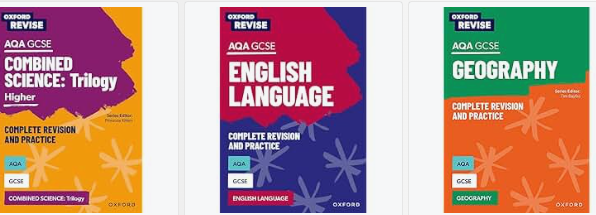
In India, students often rely on one thick textbook (like NCERT). In the UK, the focus is on active recall. Revision workbooks are designed to be “written in” rather than just read.
- Breaking Down the “Blob”: GCSE specifications are huge. Workbooks like CGP or Pearson Revise break topics into “one-page summaries” that are much less intimidating than a 300-page textbook.
- Matching the Exam Style: A workbook for “AQA Biology” will use the exact type of phrasing the AQA examiners use. This helps your child learn how to “decode” the questions.
- Bridging the Gap: For a student coming from a CBSE background, these books help transition from “writing everything I know” to “writing exactly what the mark scheme requires.”
Which GCSE Books Should You Buy?
You will see three main types of books in UK shops (like WHSmith or Amazon):
- Revision Guides: These contain the “notes” and explanations.
- Workbooks: These are full of practice questions (no notes).
- The “All-in-One”: These combine the notes and the questions in one book. (Highly recommended for Year 9).
Popular Brands: > * CGP: Famous for their silly jokes and clear diagrams—most UK students swear by them.
- Pearson/Oxford: More “academic” and formal, often used for higher-tier Maths and Sciences.
| Subject | Recommended Resource Type | Why? |
| Maths | Workbook with Worked Examples | To practice the specific steps required for UK marks. |
| English Literature | “York Notes” or CGP Text Guides | To understand the specific poems or plays (e.g., Macbeth). |
| Science | Knowledge Organisers | To memorise the specific “required practicals” for the UK syllabus. |
The “Open Formula” Shift: Application vs. Memorization
One of the biggest surprises for students moving from India is the Formula Sheet.
For exams in 2025, 2026, and 2027, the UK government (Ofqual) has confirmed that students will be provided with formula sheets for GCSE Maths, Physics, and Combined Science.
What this means for your child:
- Less Rote Learning: They won’t spend hours memorizing complex equations like the Quadratic Formula or Kinetic equations. They will have them right there on a sheet during the exam.
- It’s Not “Easy”: Don’t let the formula sheet fool you! While the formula is provided, the question won’t tell them which one to use.
- Context is King: UK exam questions are often “wordy” and based on real-life scenarios (e.g., calculating the pressure of a diver at a certain depth). Your child must be able to read a paragraph, extract the data, and select the correct formula from the sheet to solve it.
- Practice with the “Insert”: Good revision workbooks (like CGP or Collins) now include a replica of the actual 2026 formula sheet. This helps students get used to looking up the info quickly rather than panicking during the real exam.
- Step-by-Step “Decoding”: Many UK workbooks have “Worked Examples” that show how to pick a formula apart. This is the best way to train for the shift away from the CBSE style.
Parent Tip: In India, if you know the formula, you usually get the marks. In the UK, the marks are in the application. Encourage your child to practice “decoding” questions rather than just reciting equations.
The Rise of Revision Flash Cards: Quality Over Quantity
In India, “studying” often means reading a chapter over and over. In the UK, students are taught that testing yourself is better than reading. Revision Flash cards are the most popular way to do this.
- What are they? They are small, sturdy cards with a question or keyword on one side and a concise answer, diagram, or formula on the other.
- Why they work: They force the brain to “fetch” the information. This “memory workout” makes the knowledge stick much longer than just passive reading.
- Spaced Repetition: Many parents use the Leitner System with these cards—sorting them into piles based on how well the child knows them. The “hard” cards get reviewed every day, while the “easy” ones are reviewed once a week.
Premade vs. DIY Flash Cards
You’ll see two main types of cards in the UK, and both have their fans:
- Premade Revision Flash Cards (CGP, Collins, Oxford): You can buy sets specifically for your child’s exam board (e.g., AQA Biology). These are great because they cover every single point in the official syllabus, so you know nothing is missed.
- Hand-made Flash Cards: Many teachers encourage students to make their own using blank “index cards” from shops like Ryman or Tesco. The act of writing the card itself is actually the first step of learning!
Digital Flashcards (The Modern Way)
If your teen is tech-savvy, they might not even use physical cards. Many UK students use apps like Quizlet or Anki. These apps use algorithms to show the child the topics they struggle with more often, making revision very efficient.
Conclusion: Embrace moving from CBSE to GCSE
Transitioning from the Indian school system to the UK’s Year 9 is about moving from a “learning to know” mindset to a “learning to apply” approach. While the initial lack of heavy daily homework might feel like a drop in rigor, it is actually a shift toward independent research and critical thinking—skills that are vital for success in GCSEs and beyond.
The key to a smooth transition is stay involved without over-pressuring. By understanding the exam boards, utilizing active recall tools like revision cards, and focusing on pastoral well-being, you can help your teen navigate this change with confidence.
My Final Advice: Don’t worry if the first term feels like a “settling-in” period. Give your child the space to explore their new environment, join clubs, and get used to the UK teaching style. The foundation they build in Year 9 will be the springboard for their future academic success!