If your child has just started Year 12, you might already be lying awake over their A-level choices. You are nowhere near alone. A widely cited Which? University survey found that roughly one in three university applicants regretted their A-level subject choices. It’s from 2016, but the anxiety it captured hasn’t dated at all. Many wished they’d thought harder about how those choices would shape what came next.
Here’s the reassuring part: in 2026, “what comes next” isn’t just university an more. Degree apprenticeships have changed the maths on this completely. They don’t always play by the same subject rules as a UCAS application. This guide walks through how A-level choices actually affect both routes — and what’s genuinely fixed versus flexible. It also answers the question underneath all the others: what to do if your child has already chosen “wrong.”
This is a companion piece to our guide on starting sixth form. If you haven’t read that one yet, it covers the first-term basics. This one goes deeper — into the decision that quietly shapes everything after it: the subjects themselves.
Why This Question Matters More Than It Used To
A decade ago, “which A-levels” really meant “which A-levels will get you into a good university.” That’s no longer the whole picture. Degree apprenticeships have grown into a genuinely competitive alternative route, especially in finance, engineering, technology, and law. Here, a school leaver earns a full salary while an employer pays their tuition fees. They graduate debt-free, too — with both a degree and several years of work experience.
The practical effect for parents: your child’s A-level subjects are now doing double duty. They need to keep the university door open, in case that’s the eventual choice. At the same time, those subjects need to make sense on an apprenticeship application. Employers often assess these differently — on UCAS points and general aptitude, rather than a specific subject list.
Quick explainer if you haven’t met the term: UCAS points turn each qualification grade into a comparable number. (You might also see them called UCAS Tariff points.) So an offer might ask for “112 points” instead of naming exact grades. Understanding both systems at once is what makes this feel more complicated than it was for us growing up.
The “Facilitating Subjects” Myth (and What Replaced It)
A lot of the anxiety around A-level choice traces back to something that technically doesn’t exist any more. For years, the Russell Group published a list of “facilitating subjects.” These were traditional, essay- or maths-heavy A-levels — think Maths, the Sciences, English, History, and Languages. Schools and parents treated them as the safest route into a top university.
The Russell Group scrapped that list in May 2019. Critics said it was quietly disadvantaging students who took vocational, creative, or less traditional combinations. People were also misreading it as “the only subjects worth taking.”
The Russell Group replaced it with a free tool called Informed Choices. Enter the subjects your child is taking, or considering, and see which degree courses those subjects could realistically support. It’s genuinely useful for a five-minute gut-check. Just remember it’s a general guide, not a guarantee. Always cross-check against the specific university course page before ruling anything in or out.
The takeaway for parents: if your child didn’t pick three “traditional academic” A-levels, that’s not automatically a problem. What matters far more is whether their combination lines up with the course or apprenticeship they’re aiming for. That’s a narrower, much less scary question.
What Universities Actually Look For, by Course Type
Requirements vary by university and even by year, so treat this as a starting orientation rather than gospel. Always confirm on the actual course page. But as a general pattern:
| Course type | What’s typically expected |
| Medicine, Dentistry, Veterinary Science | Usually Chemistry plus Biology, and often a third science or Maths — these tend to be the most fixed requirements of any course type. |
| Engineering & Physical Sciences | Maths is almost always required; Physics is required or strongly preferred for most Engineering courses. |
| Economics | Maths is frequently required or very strongly preferred, particularly at higher-tariff universities. |
| Law, Humanities & Social Sciences | No fixed subject list at most universities. But essay-based subjects — History, English Literature, Politics, Sociology — help show the writing and argument skills these courses look for at interview and in personal statements. |
| Psychology | Varies by university — some prefer a science (often Biology) or Maths, others don’t specify at all. Worth checking course-by-course. |
| Art, Design & Architecture | A relevant Art/Design A-level plus a portfolio typically matters more than the rest of the subject combination. |
What Degree Apprenticeship Employers Actually Look For
This is where it gets genuinely different — and, in my experience, more reassuring than people expect. My own daughter is currently going through Finance Degree Apprenticeship applications for 2027 entry. The first thing that struck both of us: many employers assess on total UCAS points, not specific subjects. She’s also been using a couple of AI-powered prep platforms to get ready for the online assessments and interviews — more on those in the resources section below.
A Few Real Examples (With a Big Caveat)
HSBC’s banking degree apprenticeship, for example, asks for five GCSEs at grade 4+, including Maths and English, plus 96 UCAS points overall. It doesn’t dictate which three A-levels those points come from. Barclays’ apprenticeship route, by contrast, asks for three A-levels at grades BCC or equivalent.
There’s a clear pattern across the finance sector: a total-points or overall-grade bar is far more common than a rigid “you must have taken X, Y and Z” requirement. (Figures via Prospects, the UK’s official graduate careers service — a good bookmark for checking other employers too.)
A genuine caveat: requirements differ scheme by scheme and change from year to year. Treat the examples above as illustrations of the pattern, not as current figures to rely on. Before your child applies anywhere, check that employer’s own apprenticeship page for the live requirement. The UCAS apprenticeship search is a good starting point — but always trust the employer’s own page over any general guide, including this one.
Why Timing Matters More Than the Deadline
One more thing worth flagging while your child is still in Year 12 or 13. Degree apprenticeship applications — particularly in banking and finance — tend to open earliest, from around September. Many also run on a rolling basis. That means popular schemes close once enough strong applications come in, regardless of the advertised deadline. “I’ll apply nearer the closing date” is the single costliest mistake I’ve seen other families make with this route.
Parent tip: List every prospective degree apprenticeship with your teen in a shared Google worksheet, noting the application start date and deadline for each. It’ll help you keep on top of the applications and stay organised.
Two Routes, Two Timelines: How They Compare
| Stage | University (UCAS) route | Degree apprenticeship route |
| Applications open | 12 May 2026 (UCAS Hub); submit from 1 September 2026 | From around September 2026, varies by employer — finance/banking schemes tend to open earliest |
| Key deadline | 15 Oct 2026 (Oxbridge, Medicine, Dentistry, Vet Science); 13 Jan 2027 (equal consideration, most courses) | No fixed date — many schemes close early once filled, so early application matters more than the advertised deadline |
| Assessment | Predicted grades, personal statement, sometimes an interview or admissions test | Online tests, video interview, and an assessment centre — typically Dec–Apr |
| Offer type | Conditional offer based on predicted/actual A-level grades | Conditional job offer, often based on UCAS points rather than named grades |
| Confirmation | A-level results day (mid-August 2027) | Same results day — confirms both the degree place and the job start |
Dates above reflect the official UCAS 2027 entry timeline, current when we wrote this. Always confirm the latest dates on ucas.com nearer the time, since UCAS revises them occasionally.
“Is It Too Late to Change A-Level Subjects?”
If you’re reading this because your child has already started their A-levels and is having second thoughts, here’s the honest timeline:
- Before term starts: the easiest possible time — most sixth forms will accommodate this without question.
- During September: still generally fine at most colleges, but speak to the sixth form as soon as possible. The longer you wait, the harder it is to catch up on missed content.
- After one term: possible in many cases if your child does independent catch-up work and the school agrees. But it needs a real conversation with their head of sixth form or subject teacher.
- After a full year: generally not recommended. There usually isn’t enough time to learn Year 2 content from scratch while also revising for final exams.
Every sixth form and college sets its own policy. So the single most useful thing you can do is ask directly and early — don’t assume it’s fixed, and don’t assume it’s easy. And take some pressure off yourself and your child: between the end of the “facilitating subjects” rule and how many apprenticeships assess on overall points, the rules have genuinely loosened. A single subject swap is rarely as make-or-break as it feels in the moment.
A Checklist for Parents This Term
- Run your child’s current or planned subjects through Informed Choices to see which degree courses stay open — it takes five minutes.
- If they’re even loosely considering an apprenticeship, look up two or three specific schemes in that sector now, not next year. Note whether they quote UCAS points or named grades.
- Put the earliest known application-opening dates for those schemes in your calendar — aim to apply in the first few weeks, not the last.
- If a subject genuinely isn’t working, have the conversation with the sixth form this month, not at Easter.
- Keep a shared note of deadlines — UCAS and any apprenticeship schemes — somewhere you both check. A shared phone note or wall calendar works better than memory.
Frequently Asked Questions
Do Russell Group universities require specific A-level subjects?
No fixed list any more. The Russell Group scrapped its “facilitating subjects” list in 2019 and now points students to its Informed Choices tool. The tool shows which courses a given subject combination could support. Specific courses — Medicine, Engineering, Economics — still have their own subject expectations. Those come from the individual course, not a universal Russell Group rule.
Can you get a good degree apprenticeship without traditional academic A-levels?
Often, yes. Many finance, technology, and engineering apprenticeship schemes assess against a total UCAS points threshold or an overall grade bar, not specific A-level subjects. So a broader subject mix can still meet the requirement. Always check the specific employer’s current listing, since this varies by scheme.
Is it too late to change A-level subjects in Year 12?
It depends on timing and your sixth form’s policy. Before or during September is usually straightforward. After one term it’s harder, but sometimes possible with catch-up work and school agreement. After a full year it’s generally not advisable. Ask the sixth form directly and as early as possible.
Do apprenticeships accept UCAS points instead of specific grades?
Many do. Some banking apprenticeship schemes, for example, ask for a total UCAS points figure — combining GCSEs and A-levels — rather than naming exact subjects or grades. That gives more flexibility than a fixed-grade university offer. Requirements still vary significantly by employer, so check each scheme individually.
What’s the one thing to do this month if my child hasn’t decided their path yet?
Run their current subjects through the Informed Choices tool and look up two or three apprenticeship schemes in a sector they’re curious about. Keeping both routes visible at once — rather than assuming it’s university or nothing — is the single biggest anxiety-reducer I’ve found.
Resources Worth Bookmarking
- Informed Choices — the Russell Group’s free tool for checking which degree courses a subject combination could open up.
- UCAS: 2027 entry dates and deadlines — the official, regularly updated source for every UCAS deadline mentioned above.
- UCAS apprenticeship search — browse live degree apprenticeship listings by sector.
- The Apprentice Guide — AI mock interviews, CV and cover letter tools, and psychometric test practice. My daughter passed this along from her own applications. It’s a paid subscription after a free trial, so worth trying before you commit.
- Apprentice Lab — another one my daughter’s been using: CV scoring, mock interviews, and deadline tracking for schemes at firms like Deloitte, PwC, and Goldman Sachs. £7.99/month after a 1-day free trial.
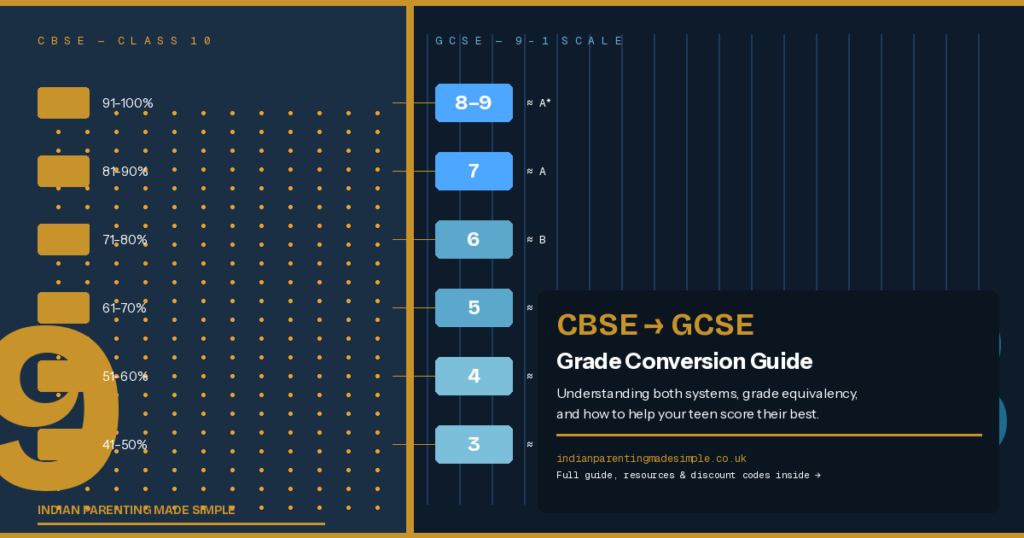
- CBSE to GCSE Conversion Guide — if you’re newer to the UK system and want the earlier-stage picture first.
- Choosing Your A Levels: and Other Academic Options by Cerys Evans — a deeper dive into subject choice if the Informed Choices tool leaves you wanting more.
- Degree Apprenticeship Application Guide by Frances Trought — the most directly on-topic pick here if your child is seriously considering the apprenticeship route.
- The Ultimate UCAS Personal Statement Guide by Rohan Agarwal & David Salt — worth bookmarking now, useful the moment personal statement season starts.
However, this term is going for your family — confident, second-guessing, or somewhere in between — the subjects on that timetable are more flexible than they feel right now. Do the five-minute checks above, have the early conversation if you need one, and know that both doors — university and apprenticeship — stay open far longer than the sixth-form induction evening made it sound.
— Tej
As an Amazon Associate, I earn from qualifying purchases.